How do we move off Airtable, Zapier, Make, Bubble or Softr to our own system?
Move one process at a time into one system in your own accounts: your data in a real database, the workflows as code that you own, and screens for each role. It is built next to your current setup, and you switch once it runs on your real data. A first version can be working within a week, for a fixed price from $1,990 agreed before work starts.
Moving is worth it when you hit record or plan limits, pay for many tools that each do one part, or keep fixing automations that break. If the current setup works and costs little, keep it.
- Runs in your accounts
- You own the code and data
- No fee to leave
Teams that know where the hours go, but have no developer.
- Teams on Airtable or Softr hitting record limits, per-user prices or missing features
- Companies paying for many Zapier or Make steps that break and are hard to trace
- Owners of a Bubble app who want the product in their own accounts and code
Not a fit if the current tools work, cost little and nobody is fixing them every week.
The first build: one process, working, in your accounts.
- One process, end to end: the one that costs your team the most time
- A working version on your real data within a week
- Built in your accounts: you own the code, the data and the logins
- Error alerts and a log of every run
- A written runbook and a Loom walkthrough
- Two weeks of fixes after launch
- A typical first build moves the most painful workflow and its data, while everything else keeps running on the old tools. Bigger systems continue in fixed stages, each scoped and priced in writing before it starts.
Airtable or Softr
Tables, records and attachments moved into a database in your accounts, with logins and roles.
Zapier or Make
Fragile chains of steps rebuilt as one workflow with error alerts and a log of every run.
Bubble
The product rebuilt in your own code and accounts, screen by screen, while the current app keeps running.
From the first call to a working system in about ten working days.
- DAY 130-minute callYou show the process on a screen share. I ask where the hours go.
- DAY 2Scope and fixed priceOne page: what gets built, what doesn't, the price and the date.
- WEEK 1First version workingThe most expensive step runs on your real data, in your accounts.
- WEEK 2Full workflow and handoverError alerts, a written runbook and a Loom walkthrough.
Two weeks of fixes are included after launch. After that you can keep me on for changes, or run it yourselves with the runbook.
Build it yourself, hire a gig, hire an agency, or us.
| OPTION | COST | TIME TO A FIRST VERSION | PROOF YOU CAN CHECK | WHO OWNS IT | BEST FOR |
|---|---|---|---|---|---|
| Build it yourself with a no-code or AI builder | About $20–400 a month for the tool (Softr $19–395, Noloco $65–79, Lovable from $25 plus credits), plus your team's time | Depends on who on your team has the hours | Your own testing | Your data; the app lives on the vendor's platform and plan limits | Simple processes and a team member who enjoys building |
| Freelancer gig (Upwork, Fiverr, Contra) | $500–2,500 for a small tool on Upwork's fixed-price listings | From 72 hours to a few weeks | Platform ratings; case studies are rarely shown | Depends on the freelancer | A small, clearly defined task |
| Development agency | $13,000–25,000 fixed for an internal tool with 1–3 integrations (RapidDev); A$5,000–60,000 (Sandlabs); paid audits first: $2,000 (Build Simple Systems), A$2,999 (Sandlabs) | 2–10 weeks to the first release | Portfolios, review sites | Usually yours by contract | Large systems and a team over many months |
| lowcoding.dev | From $1,990 for the first build, fixed and agreed before work starts; next stages priced in writing | A working version in 1 week | 24 case studies with client names, numbers and reviews | Runs in your accounts; the code and data are yours; no fee to leave | Small teams that want one process working fast, then more in stages |
Prices as each provider publishes them, checked 13 November 2026: Softr pricing (2026 plans, via Toolradar check of 31 Oct 2026), Noloco pricing, Lovable pricing, Upwork fixed-price tool listing, RapidDev cost page, Sandlabs, Build Simple Systems.
Two systems built for real clients.
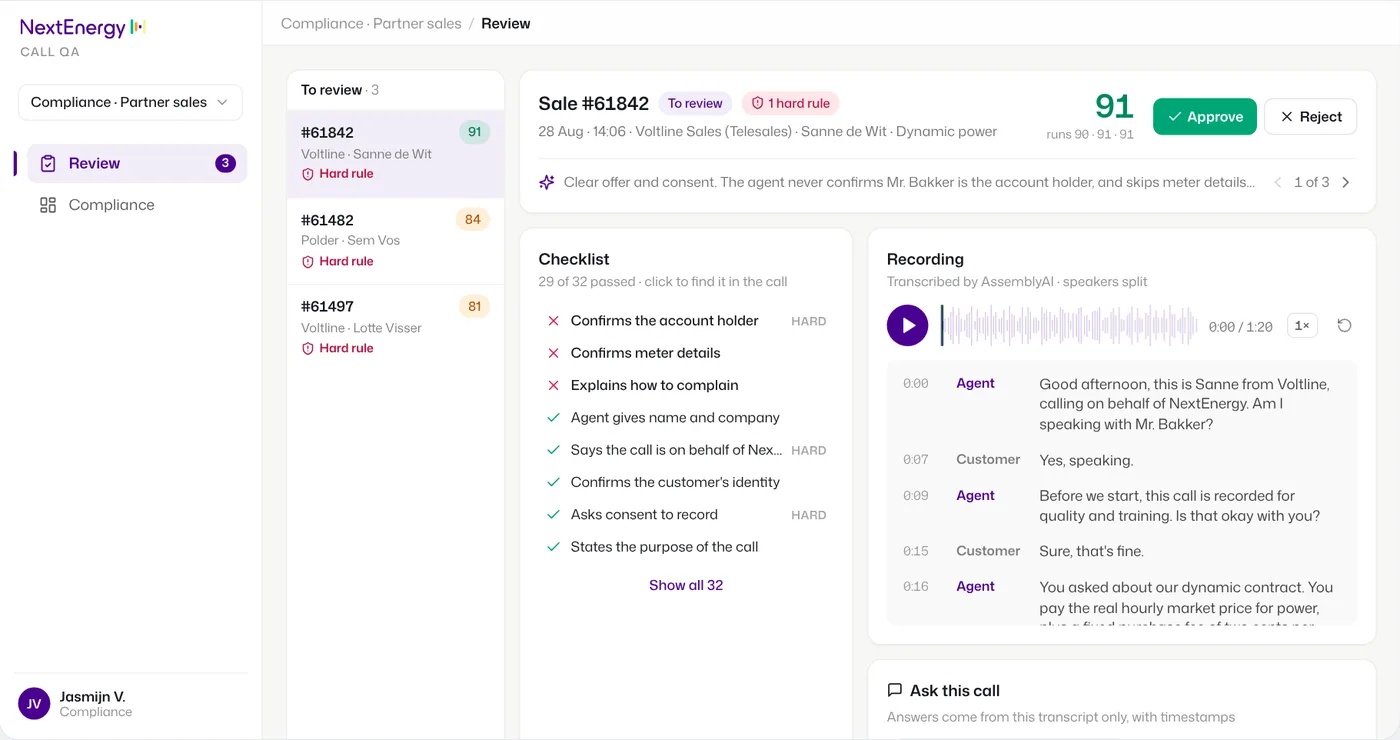 NextEnergy · Utrecht, Netherlands
Every sales call to a Dutch energy supplier, transcribed and compliance-scored automatically
NextEnergy's compliance team checked partner sales calls by hand. I replaced a fragile Make.com flow with an n8n pipeline and web app that pulls FTP recordings, transcribes them, scores compliance with AI and charts trends.
- 5,000+
- sales calls transcribed and scored
- Every call
- checked against 30+ compliance criteria, instead of spot checks
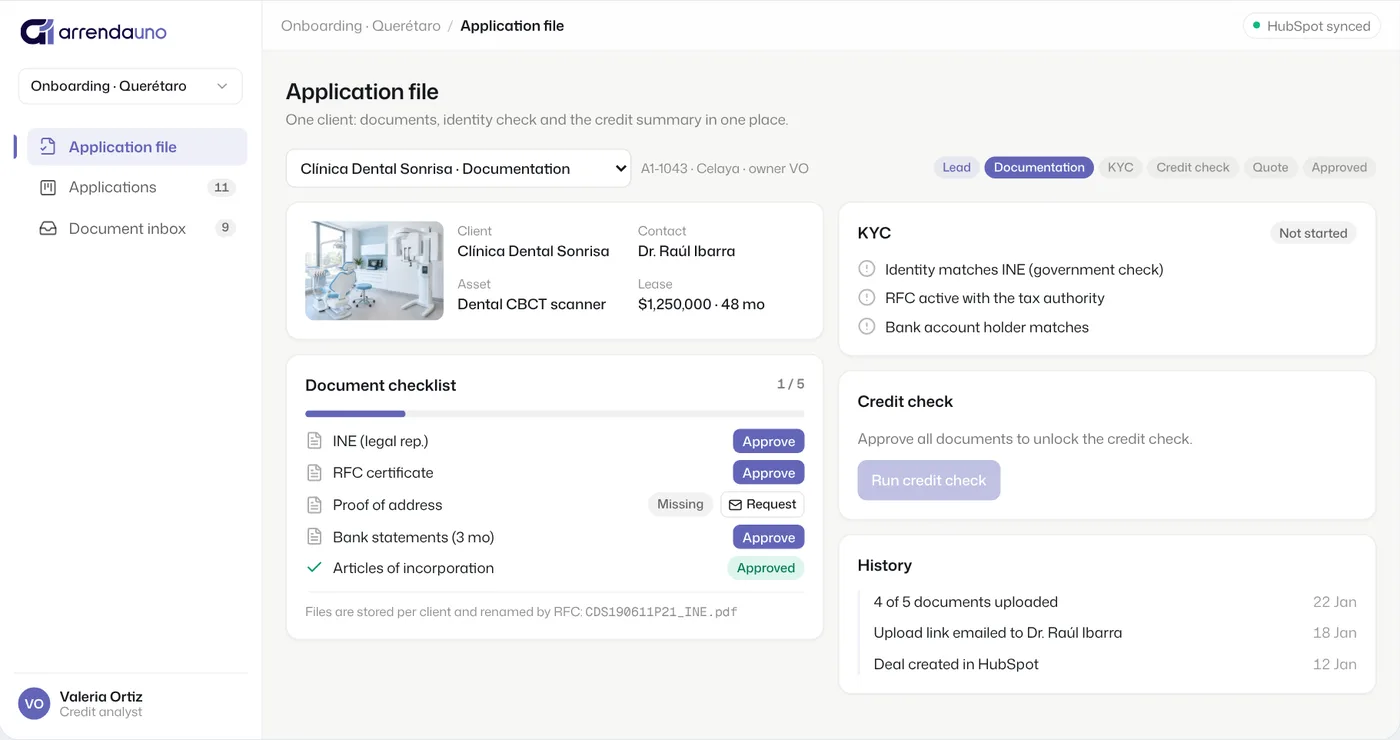 Arrenda1 · Querétaro, Mexico
Leasing applications moved from Notion and Drive into one onboarding system
A document-upload portal shipped in one week grew into a full client onboarding system for a Mexican leasing company: KYC, credit-bureau reports and HubSpot-driven documentation stages, on Bubble, Supabase and Make.
- 1 week
- from brief to a working document-collection form, fully documented
- ~11 weeks
- from kickoff to V1.0 testing of the full onboarding flow
What people ask before they start.
How much does it cost?
The first build starts at $1,990, with the scope and a fixed price agreed on one page before any work starts. Bigger systems are split into fixed stages, and each next stage is scoped and priced in writing after you've seen the first one run.
Does our current setup keep running during the move?
Yes. The new system is built next to it, and you switch once it runs on your real data.
Should we move everything at once?
No. Move the process that hurts most first. The rest follows in fixed stages, each scoped and priced in writing, or stays where it is if it works.
Do we own what you build?
Yes. It runs in your own accounts, and the code, the data and the logins are yours. It comes with a runbook, so another developer or your own team can take it over. There is no fee to leave.
Why not keep adding to the no-code setup?
More steps on the same tools keep the same record limits, per-user plans and breakages. Moving gives you a system you own and can change without hitting a plan wall.