Custom software development cost in 2026, priced from your own scope

- Published
- 26 November 2026
Agency guides put a simple custom app at $5,000 to $15,000 and one to three months to build. Once it's live, a small business app like the one in this guide costs about $45 a month to run. Write a one-page scope before you ask anyone for a number, because the scope sets the price and lets you compare quotes.
Custom software development cost by route
| Route | To build | To run, per month | Year one | Fits when |
|---|---|---|---|---|
| Ready-made software for your trade | No build; set-up and training | Example, shopVOX Express: $109 with 1 user plus $29 per extra user, $312 for 8 users | $3,744 plus set-up and training | Your process is the same as most firms in your trade |
| Airtable + Softr (no-code) | No code; your set-up time | 8 Airtable Team editors at $20 + Softr from $19, billed yearly: $179 | $2,148 plus your set-up hours | A team under 10 with simple rules |
| Your own app, built by you with Claude Code | Claude Pro $20 a month while you build, and about 120 hours of your time (example) | About $45 hosting | About $600: 3 months of Claude Pro plus 12 months of hosting, and your hours | You like building and can test carefully |
| Your own app, built by a hired builder | A quote. Two agency guides put a simple project at $5,000 to $15,000 | The same $45 hosting, plus upkeep | The quote, plus hosting and upkeep | You want it built and looked after for you |
| Your own app, built by us (lowcoding.dev) in your accounts | From $1,990, fixed before work starts: one process working on your real data in 1 week. Bigger systems continue in fixed stages, each priced in writing | The same $45, paid to the providers. Upkeep is optional, from $1,000 a month | From $2,530, plus upkeep only if you choose it | You want a fixed price agreed before work starts |
Seat counts are for 8 daily users, the size of the example company below. The hosting figure is Supabase Pro ($25), the database, plus Vercel Pro ($20), which runs the code. Only the person who deploys needs a Vercel seat; the staff who use the app don't.
The ranges you see in search results come from agency cost guides. EitBiz and Finoit put a simple project at $5,000 to $15,000, and EitBiz adds 30 to 90 days. Soft Suave's guide starts small projects at $15,000 and 2 to 4 months, and Integrio's puts web apps at $25,000 to $100,000. Claude Code can write the code, but people still spend hours deciding what the app must do, moving the old data in, testing it and keeping it running. This guide prices those parts for one company, step by step, so you can do the same for yours.
The example: Kestrel Signs and the app it wants
Kestrel Signs makes and installs signs for shops and offices. It has 16 people: the owner, two office staff, a designer, eight in production and two install crews of two. About 220 quote requests a month turn into about 140 jobs.
Quotes are priced in an Excel calculator only one office person fully understands. Jobs live in a shared Google Sheet, production runs off a whiteboard, and installs are agreed by text. Customers call to ask where their sign is. The owner counts about 25 office hours a month spent retyping orders and answering status calls.
The owner wants one app: quote, job, proof, production and install in one place, with a status link the customer can open. 8 people would use it every day: the two office staff, the designer, the production lead and the four installers.
Step 1: write a one-page scope from what you already have
Every price in this guide depends on the scope, the written page that says what the app does and who uses it. Without that page, each builder quotes the app they imagine, and the quotes can't be compared.
You don't have to write it from scratch. Claude can read your website and your files, then interview you about the rest.
Set-up, in the Claude app: Customize → Connectors → Google Drive → Connect, sign in on Google's page, then under Tool permissions set search and read to Always allow and every tool that creates, moves or shares files to Blocked (how connector permissions work). Put the files that show the job today (the quote calculator, the job sheet, a photo of the whiteboard) in one Drive folder. No Drive? Attach the same files to the chat.
I want a quote for custom software for my business. Help me write a one-page scope a builder can price. 1. Read my website [URL] to learn what we sell and to whom. 2. In the connected Google Drive, read only the folder [folder name]: these files show how the job runs today. Don't copy customer names, emails or phone numbers into your answer. 3. Interview me one question at a time about what you can't see: who does each step, what goes wrong, which tools must stay, what the app must never do. Suggest the likely answer each time so I can confirm or correct it. 4. When I say "done", write the scope on one page: the problem in two sentences; the people who use it and what each may see and change; every screen with what it shows; the records it keeps; the rules (prices, statuses, who approves what); other tools it reads from or sends to; the old data to move in and how many rows; what is out of scope for version 1; and how we'll know it works. 5. Keep it plain. No technology choices unless I named one.
Problem: quotes, jobs and installs live in an Excel calculator, a Google Sheet, a whiteboard and texts. Office staff retype every order and answer status calls. People: office (2) create quotes and jobs, see everything; designer uploads proofs; production lead (1) moves jobs between stages; installers (4) see only their installs on a phone; customer opens one status link per job, no login. Screens: quote builder; job board by stage; job page with proofs and files; install calendar; installer's day on a phone; customer status page; owner's weekly report. Records: customers, quotes, quote lines, jobs, proofs, installs, price list (materials and labour). Rules: prices from the price list with the calculator's 14 adjustments; a job starts only after the proof is approved; an install is booked only for a job in Ready. Other tools: new quote requests from the website form email; jobs marked Installed create a draft invoice in QuickBooks Online. Old data: 2 years of jobs in the Google Sheet, about 3,100 rows. Out of scope for version 1: online payments, stock levels, the designer's file storage. Done when: a job goes from request to installed without anyone retyping it, and the customer link shows the right stage.
Step 2: size the scope by what drives the price
Five things drive a build estimate, and the prompt below counts each one: the number of screens, the people and what each may see, the other tools it talks to, the old data you move in, and the rules. A sixth, AI features such as reading emails or documents, adds a model fee per use on top. Ask Claude to count them and to flag what you could leave for version 2.
Here is my one-page scope: [paste it, or attach scope.md]. 1. Count: screens, user roles, other tools it reads from or sends to, old data to import (rows and files), and business rules. 2. For each item, say how hard it is for a builder (small, medium, large) and why in one line. Mark anything with money, permissions or another company's API as at least medium. 3. Estimate the build in hours for one experienced builder working with Claude Code, as a range, and say what the range depends on. 4. List up to 5 items I could move to version 2 to make version 1 smaller, and what each one saves. 5. List the questions a builder will ask before quoting that the scope doesn't answer yet.
Screens 7, roles 4 plus the customer link, other tools 2 (website form email in, QuickBooks Online out), old data 3,100 rows, rules 5 groups. Large: the quote builder (14 price adjustments copied from the calculator, each needs a test), QuickBooks Online (another company's API, sign-in and error handling). Medium: roles (installers see only their installs), the 3,100-row import (dates and customer names typed many ways), the customer status link (no login, so it must not be guessable). Small: job board, install calendar, owner's report. Build estimate: 60 to 100 hours. The low end needs the price rules written down with examples; the high end is QuickBooks plus a messy import. Version 2 candidates: QuickBooks (save 15 to 25 hours, export a CSV for your bookkeeper instead), owner's report (save 4 hours), the installer phone view (save 6 hours, print the day sheet). Questions a builder will ask: Who signs in with what (Google accounts?). Which QuickBooks plan? What happens to a quote when prices change? Who can delete a job?
Kestrel's owner moved QuickBooks to version 2. That one cut takes the riskiest part out of version 1, and the bookkeeper gets a CSV export each week instead.
Step 3: add the monthly running costs
Kestrel's version 1 runs on five services, and three of them stay on a free plan at about 140 jobs a month.
| Service | What it does | Plan | Per month |
|---|---|---|---|
| Supabase | The database, sign-in and file storage | Pro (Free pauses after a week without use) | $25 |
| Vercel | Runs the app on the web | Pro, one deploying seat (Hobby is for non-commercial use) | $20 |
| Resend | Sends sign-in emails and the status link | Free: 3,000 emails a month, 100 a day | $0 |
| Sentry | Tells you when the app throws an error | Developer (1 user) | $0 |
| UptimeRobot | Checks the app is up every 5 minutes | Free | $0 |
| Total | $45 |
An AI feature adds a model fee per use: reading each quote request email would cost cents per email on the Claude API, priced the way our AI agent cost guide does it. Kestrel's version 1 has none.
Compare that with the subscription routes in the first table. Their seat prices grow with every person you add, while $45 stays the same at 8 users or 30.
Step 4: get quotes you can compare
Send the same scope to two or three builders and ask each the same questions. Claude can turn your scope into the request.
Turn my scope [attach scope.md] into a short quote request email I can send to builders. Ask each builder to answer these in writing: 1. A fixed price for version 1 as scoped, or an hourly rate with a cap. What is included and what is extra. 2. How long until a working version I can click through, and until it's live. 3. Whose accounts it runs in. I want the code, the database and the hosting in accounts I own from day one. 4. How changes after my first review are priced. 5. What upkeep costs per month after launch and what it covers (updates, fixes, small changes, backups). 6. How old data gets moved in and checked. 7. How they test it before handover, and what I get at handover (code, logins, a short guide). Keep the email under 250 words. Attach the scope rather than pasting it.
Kestrel sent it to three builders, and the answers to questions 3 and 5 sorted them fastest. Builder A quoted $4,500 with the app hosted on A's own account for $350 a month, so Kestrel would pay every month to reach its own data and couldn't take the code elsewhere. Builder B quoted a fixed $9,000 with one review round, in Kestrel's accounts, and upkeep at $400 a month. Builder C quoted $95 an hour for an estimated 80 to 110 hours, with every change after the first review billed by the hour and no cap.
Walk away from a builder who won't put the code and the data in your accounts. Ask again when a quote has no written list of what's included or no review round before launch.
Step 5: if you build it yourself, set up the accounts and keys first
Skip this step if a builder does the work, and hand them the checks in step 7 instead. Building it yourself costs Claude Pro ($20 a month, Claude Code included, per Claude's plans page) and your evenings. Kestrel's owner took the middle of the step 2 estimate and added half again for a first build: about 120 hours. Two mistakes are hard to undo once the app is live: a secret key in the browser code, which skips every access rule, and a role that sees too much. Set up the accounts before the first prompt. Build your own CRM walks through a full build; these are the accounts any custom app needs.
- GitHub: create a private repository for the code. Everything else connects to it.
- Supabase: create a project, then open Settings → API Keys. The publishable key is safe in the browser; the secret key bypasses your access rules and must never be in browser code or in the repository (Supabase API keys).
- Vercel: import the GitHub repository, then add the keys under the project's Environment Variables, with the secret ones as type Secret. Changes apply only after a redeploy (Vercel environment variables).
- Resend: create an API key with Sending access only, and add your domain's DNS records exactly as shown (Resend API keys).
Where the keys live while Claude Code works on your computer: in a file called .env.local in the project folder. A .env file is a plain list of names and values (SUPABASE_SECRET_KEY=...) that the app reads at start. Add .env.local to .gitignore so it never goes to GitHub, fill in the values in your own editor (never paste a key into the chat), and add a deny rule such as Read(./.env.local) to .claude/settings.json (Claude Code settings). The rule stops Claude's file tools opening the file; it isn't a hard wall, because a script Claude runs could still read it, so keep live keys in Vercel and use a test project on your computer. Claude Code on the web: put test values in the environment's Environment variables (anyone using that environment can read them) and real secrets in Network secrets, then start a new session (cloud environments).
Read scope.md in this folder. Before writing any code: 1. Propose the database tables and, for each role in the scope, what it may read and change. Write them as access rules (Supabase row-level security), and list them for me to approve. 2. Propose the order of work in slices I can click through after each one: sign-in and roles first, then the screens in the order the work flows, the import last. 3. List every key and setting the app needs, with where I create each one. Write .env.example with names only and make sure .env.local is in .gitignore. Never ask me to paste a key here. Wait for my OK, then build slice 1 only, with a test that a user of each role can see only what the scope allows.
Step 6: add the review round and the upkeep, then total year one
Year one also holds a review round and upkeep. The review round comes first: at Zappyrent, the COO's first review changed the scope and took the job from about two weeks to about a month. Budget time and money for that round before you start.
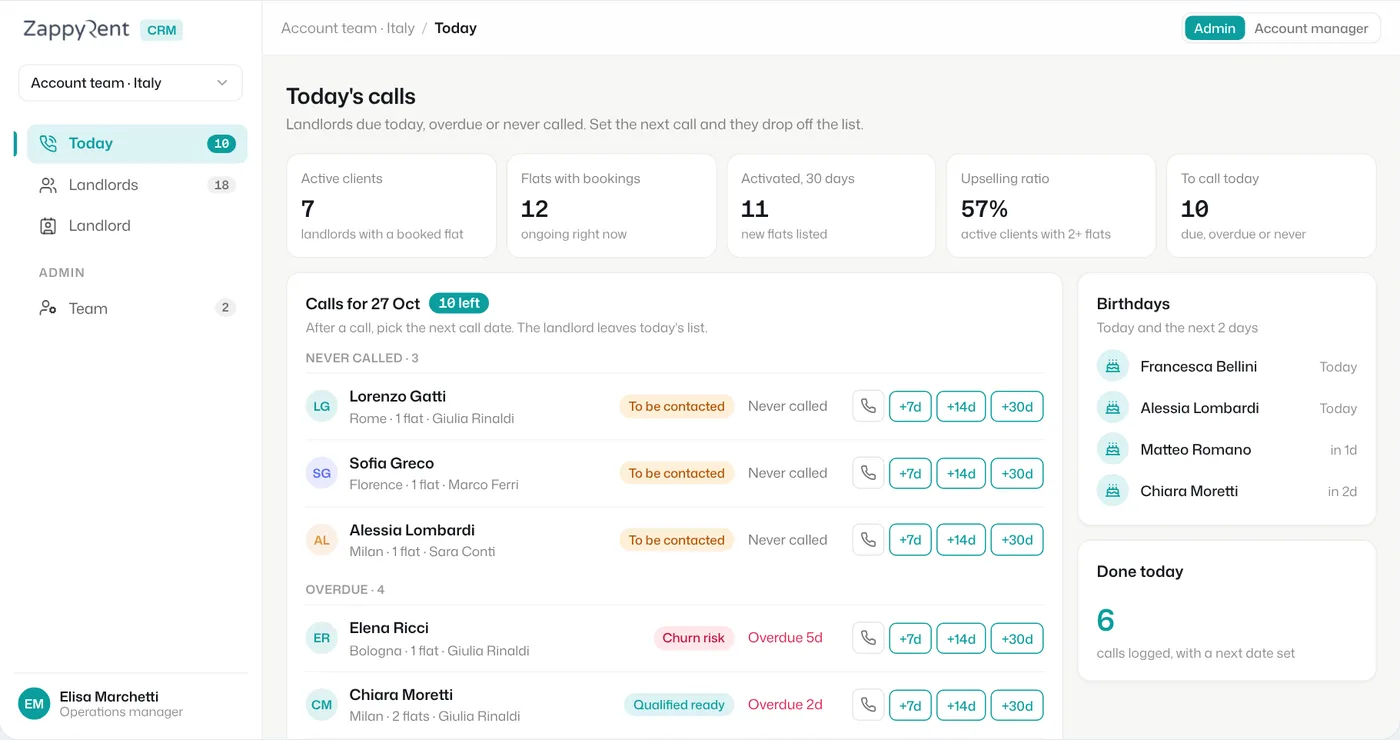
A CRM built in two weeks, finished in about a month
AI runs on · Retool on the client's live PostgreSQL database
Zappyrent's account managers needed a daily call list of landlords, read from the live booking database. We had a version in front of the COO about two weeks after getting access, and about ten people on the team now use it daily.
The COO's feedback at the review went into the written scope, and the refinements took the job from about two weeks of build to about a month in all.
Upkeep comes after launch: library updates, notices from Supabase or Vercel, small changes, and a backup you have actually restored once. Supabase Pro keeps daily backups for 7 days, and supabase db dump makes a copy you keep yourself. None of the agency cost guides above gives upkeep as a share of the build. Carey Enterprises, one of the firms ranking for this search, sells support plans at $297 to $1,197 a month on top of a build from $5,000. Kestrel's owner budgets about 2 hours a month (example) for updates and a backup check if the app is built in-house.
Then put every route on one line for 12 months, next to what the job costs you today. Kestrel's office spends about 25 hours a month on retyping and status calls. At an example wage of $24 an hour that is $600 a month, or $7,200 a year. The owner's other option was a third office person, and one admin hire costs a US employer about $59,000 a year all-in.
Help me compare year one for my custom software project. Ask me for each number one at a time and suggest a likely answer I can correct: hours a month the job takes today and the hourly cost of the people doing it; for each route I'm considering (ready-made software, no-code, build it myself, each builder's quote), the build price, monthly fees, my own hours to set up or build, and upkeep per month. Then give me a table: route, cost in year one, cost in year two, hours of my own time, and months until it pays for itself against today's cost. Show your sums. Say which route is cheapest in year one and which in year two, and what would change the answer.
Today: 25 h/month × $24 = $600/month, $7,200/year. shopVOX Express, 8 users: $312/month = $3,744 a year, plus set-up and training. Year two the same. Check in a trial that it can price your 14 adjustments. Airtable + Softr: $179/month = $2,148 a year, plus about 40 h of your set-up. Year two the same. Check in a trial whether Airtable formulas can hold the 14 adjustments; if not, quotes stay in Excel. Third office person instead: about $59,000 a year all-in (US), every year. Build it yourself: $600 in year one plus about 120 h, then $540 a year plus about 2 h/month. Pays back in the first month after launch (about month 4), saving $555 a month after hosting, if your hours are free. At $24 an hour they're worth $2,880. Builder B: $9,000 + $540 hosting + $4,800 upkeep = $14,340 in year one, then $5,340 a year. Saves $155 a month after upkeep and hosting, so the build pays back in about 58 months. Without upkeep, in about 16. Cheapest in year one and year two: build it yourself, if your 120 hours are free. A builder's route costs less than shopVOX in year two only while upkeep stays under $267 a month.
Step 7: test it before you pay the last invoice
Whoever builds it, check these yourself before launch, or before the final payment if a builder did it. Each line has a test that either passes or fails.
| Check | Passes when |
|---|---|
| Roles | Signed in as an installer, you see only your installs, and a typed job address for another crew shows nothing |
| Status link | The status link shows one job, can't be guessed by changing a number in it, and stops working when you turn it off |
| Price rules | Ten real past quotes, re-entered, come out at the same price as the old calculator |
| Old data | The row count after import matches the sheet, and five random jobs match line by line |
| Keys | No key appears in the GitHub repository, and the secret key isn't in the page source in the browser |
| Backups | You made a copy with supabase db dump, loaded it into a test project, and the data was there |
| Ownership | The code, the database and the hosting are in accounts you own, and you can sign in to each without the builder |
| Errors | A deliberate error shows up in Sentry, and an outage alert from UptimeRobot reaches your phone |
| Exit | You can export every table as CSV without asking anyone |
Run the first week in parallel: new jobs go into the app, and the old sheet stays read-only next to it. If something doesn't match, you still have the old way for that week.
Where ready-made software is the better pick
Buy when your process is the same as most firms in your trade. One trade package Kestrel looked at, shopVOX, costs $109 a month for one user on its Express plan plus $29 for each extra user, so $312 a month for 8 people. Its PRO plan is $249 plus $49 per extra user. shopVOX works the day you sign up and ships its own updates. Kestrel's app gets updates only while someone is paid for upkeep or the owner spends the 2 hours a month.
No-code fits a team under 10 with simple rules. Airtable alternatives compares the options, and spreadsheet to app covers when a sheet should become an app.
Custom software is the better pick when a trial shows your rules don't fit, for example if shopVOX can't hold Kestrel's 14 price adjustments, or when seat prices grow faster than the team's budget.
When custom software costs more than it saves
- The job is small. A $5,000 build, the low end of the guides' range, pays back in about 9 months against Kestrel's 25 hours a month, after the $45 running costs. At 5 hours a month ($120) it takes about 5.6 years, and with paid upkeep it never pays back.
- Nobody owns it. An app needs one person who decides what changes and checks the weekly report. Without that person, change requests pile up unanswered and staff go back to the sheet.
- You can't write the scope. If the interview in step 1 ends with "it depends" on most questions, the process isn't settled yet, and a builder would be guessing.
- You need payroll, tax or accounting rules. Buy software that is kept up to date with the law, and connect your app to it if you must.
Questions people ask
- How much does custom software development cost for a small business?
- How much does software maintenance cost?
The cost guides ranking for this search don't give one percentage. One firm, Carey Enterprises, sells support plans at $297 to $1,197 a month. For a small own app, hosting is about $45 a month, and upkeep is about 2 hours a month of someone's time or a builder's monthly fee.
- How much does it cost to update software?
Ask your builder to price small changes before you sign, such as a new job status in Kestrel's app, which touches one table and two screens. A change to who can see what, or a new connection to another tool, is a small project of its own: write it down like the scope in step 1 and get it priced.
- Is software development opex or capex?
Ask your accountant, because it depends on your country and your accounts. In US accounting rules, FASB's ASU 2025-06 says internal-use software costs are capitalized once management has committed to funding the project and it is probable it will be finished and used. It applies to annual periods beginning after December 15, 2027, and early adoption is allowed.
- Can I build my own software?
Yes, for a small internal app. Claude Code writes most of the code, and the hard parts are the scope, the access rules, the keys and the testing in steps 5 and 7. Kestrel's estimate was about 120 hours of evenings.
- What is custom software?
Software built for one company and owned by it. Kestrel's would hold the calculator's 14 price adjustments and its own job stages.