Build your own CRM with Claude Code: when it beats HubSpot, what it costs, 4 we built

- Published
- 15 November 2026
- Prices checked
- 15 November 2026
Build your own CRM when your process is unusual, your data already lives in your own database, or per-seat bills keep growing. With Claude Code a first version takes about a week and runs for roughly $45 a month in hosting. Buy HubSpot when a standard sales pipeline and marketing email cover what you do.
Buy HubSpot or build your own CRM: the short version
| Route | Cost, checked 15 Nov 2026 | Time to start | Who owns it | Fits |
|---|---|---|---|---|
| HubSpot Free | $0 for up to 2 users | Today | HubSpot | A founder and one helper with a simple pipeline |
| HubSpot Sales Hub Starter | $20 per seat a month; new-customer discounts from $7 | Today | HubSpot | A small sales team on a standard pipeline |
| HubSpot Sales Hub Professional | $90 per seat a month billed yearly, $100 monthly, plus a required $1,500 onboarding | Weeks, with onboarding | HubSpot | Sales teams that want sequences, automation and reports out of the box |
| Custom CRM from a dev agency | $45,000–100,000 for an MVP; $1,500–3,000 a month to run (one agency's published range) | 12–20 weeks | You, if the contract says so | Bigger firms with a long list of requirements |
| Your own CRM written with Claude Code | About $45 a month hosting plus the build; ours start at $1,990 | About a week to a working version | You: your GitHub, Supabase and Vercel | A process no off-the-shelf CRM fits, or data you already own |
Swipe the table sideways for all columns. HubSpot prices from hubspot.com/pricing/sales; agency range from RaftLabs (updated 11 Nov 2026); hosting from supabase.com/pricing and vercel.com/pricing. All checked 15 November 2026, US dollars.
We have built four CRMs for clients between 2023 and 2026. Only the newest was written with Claude Code. The other three used Bubble, Retool and Lovable, the tools we used then. Each one is below with what it cost in time, one number from its case page, and what we'd change if we built it today.
When your own CRM beats HubSpot
HubSpot is good at the common case: contacts, companies, deals in stages, emails and tasks. Your own CRM wins when your business isn't the common case. Five signs, each from a build:
- The CRM has to run the money. A legal-services company needed payment plans for 15,000 clients, charged through three processors with every attempt logged. A sales CRM tracks deals; this one had to collect payments.
- Your data already lives in your own database. Zappyrent's bookings, landlords and listings were in its own PostgreSQL. The CRM read them live. No sync, no exports, no second copy to drift.
- Your "contacts" aren't leads. A clothing brand's CRM manages 20 creators, deals that include the clothes sent, and cost per view. Bending a sales pipeline into that takes more work than building it.
- AI has to read every record. The funding broker's app sorts every outreach reply into one of 8 intents and matches it to a contact. That runs inside the app on every reply, not as an add-on.
- Seats cost more than the work they do. Ten people who only log calls still need paid seats in most CRMs. Your own app charges for hosting, not people.
If none of these apply, buy. A standard pipeline is a solved problem.
What a custom CRM costs in 2026
| Route | Build or setup | Running, per year | First year |
|---|---|---|---|
| HubSpot Sales Hub Professional, 10 seats, yearly billing | $1,500 onboarding | $10,800 | $12,300 |
| HubSpot Sales Hub Starter, 10 seats, $20 list price | $0 | $2,400 | $2,400 |
| Agency MVP (published range) | $45,000–100,000 | $18,000–36,000 | $63,000–136,000 |
| Own CRM with Claude Code, first version with us | From $1,990 | About $780 | From about $2,770 |
Swipe the table sideways for all columns. Our arithmetic on list prices checked 15 November 2026: HubSpot from hubspot.com/pricing/sales; agency range from RaftLabs. Own CRM running cost = Supabase Pro $25 + one Vercel Pro seat $20 + Claude Pro $20 a month (supabase.com, vercel.com, claude.com). Excludes AI usage by the app and email sending.
Three things the table hides:
- A first version is not the whole CRM. Ours covers one process end to end in about a week. A CRM as wide as the broker's grows in stages over weeks, each priced in writing before it starts.
- Someone owns it. With your own CRM you own the accounts, the backups and the fixes. Claude Code makes changes cheap, but someone has to ask for them and check them.
- HubSpot's price grows with you too. Professional adds $90–100 a month for every new seat.
For the do-it-yourself route, the hosting is the same and the build is your time plus a Claude plan. Pro at $17–20 a month includes Claude Code.
4 CRMs we built, and what each one taught us
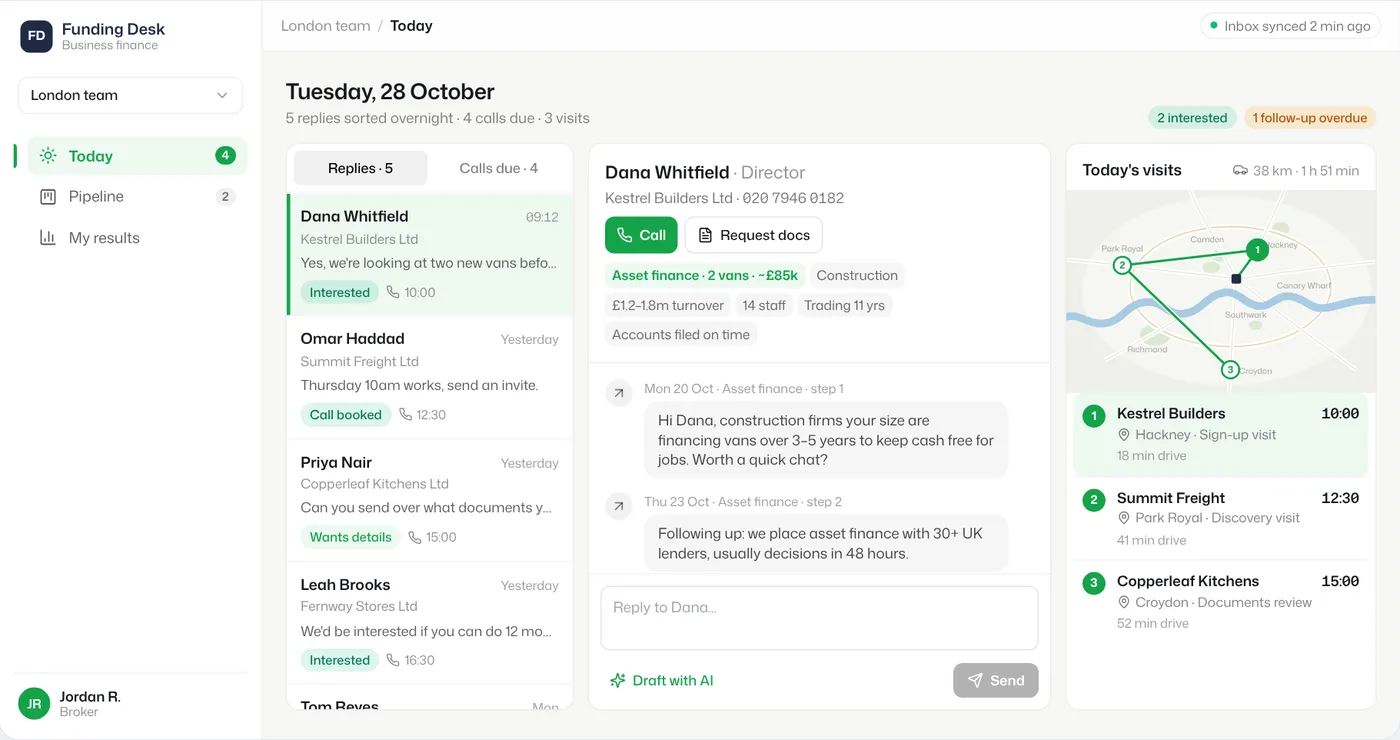
Revenue-ops CRM for a UK funding broker
AI runs on · Built with Claude Code. Next.js and Supabase on the client's own Vercel; AI sorts every reply into 8 intents
One app holds the leads from a public-register waterfall (57,291 raw companies into 14,620 qualified leads), the contacts, the funding pipeline and the follow-up sequences. Existing leads came in from Monday.com so nothing was lost. Outreach activity flows back from the sending tool.
Both apps ran on the client's own accounts less than 3 weeks after the broker side was onboarded. The CRM keeps growing with the COO through a request flow.
The old CRM looked automated but wasn't. 32 follow-up rules on the Monday board had stopped firing in July, 498 follow-ups were more than 30 days overdue, and the next follow-up date had been typed by hand 187 times. We audited all 32 and rebuilt the 12 that mattered.
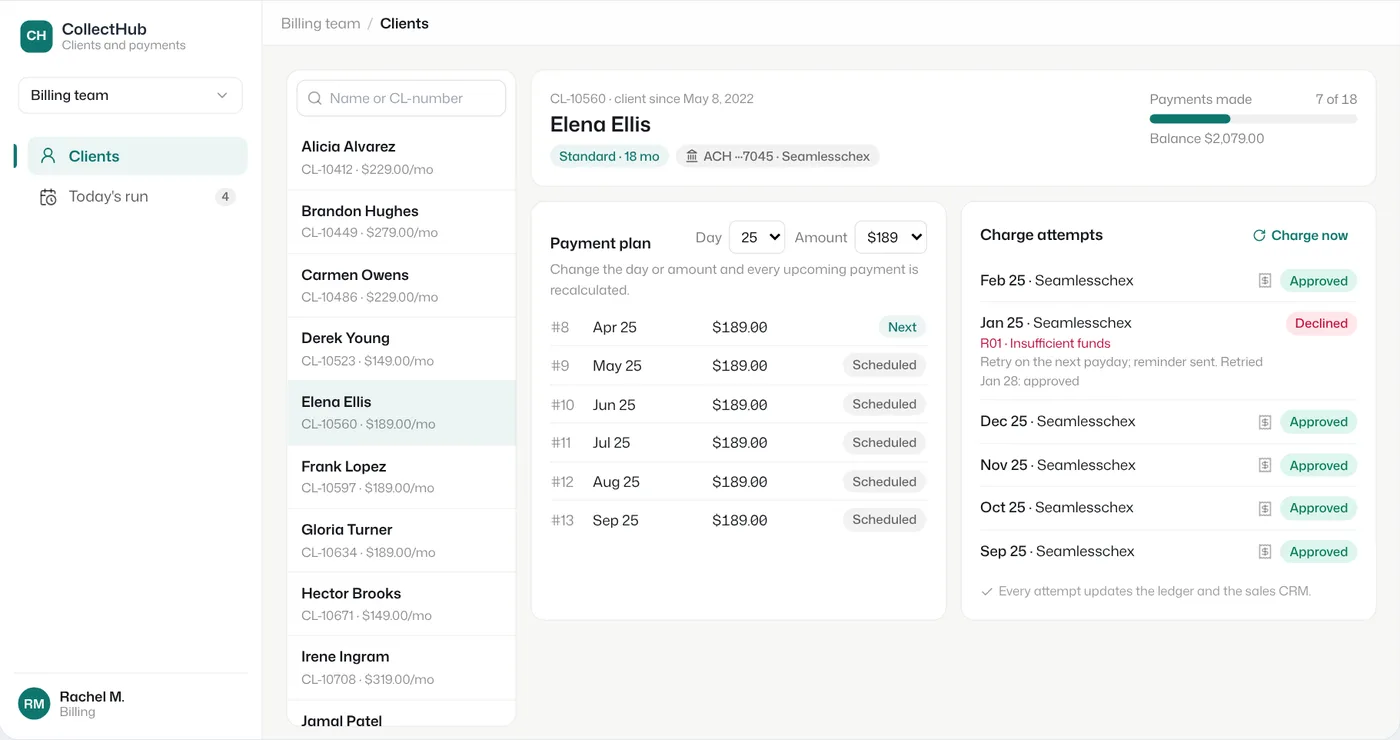
Client and payments CRM for a US legal-services company
AI runs on · No AI in this one. Bubble inside the sales CRM, Make, PostgreSQL on AWS, Stripe and two other processors
Client records lived in one tool and payments in three processor accounts. Missed payments cost more than $100,000 on a bad day. Our team built one CRM in under 3 weeks: a screen per client inside the sales CRM, payment plans that generate their future payments, charges through three processors, retries and reminders, and a ledger with receipts. It handles more than 100,000 payment operations a month.
Payments went live in March 2023. The hard part came after: mapping the old system's fields, importing history tables and cleaning the data took through April. Plan the migration as its own stage.
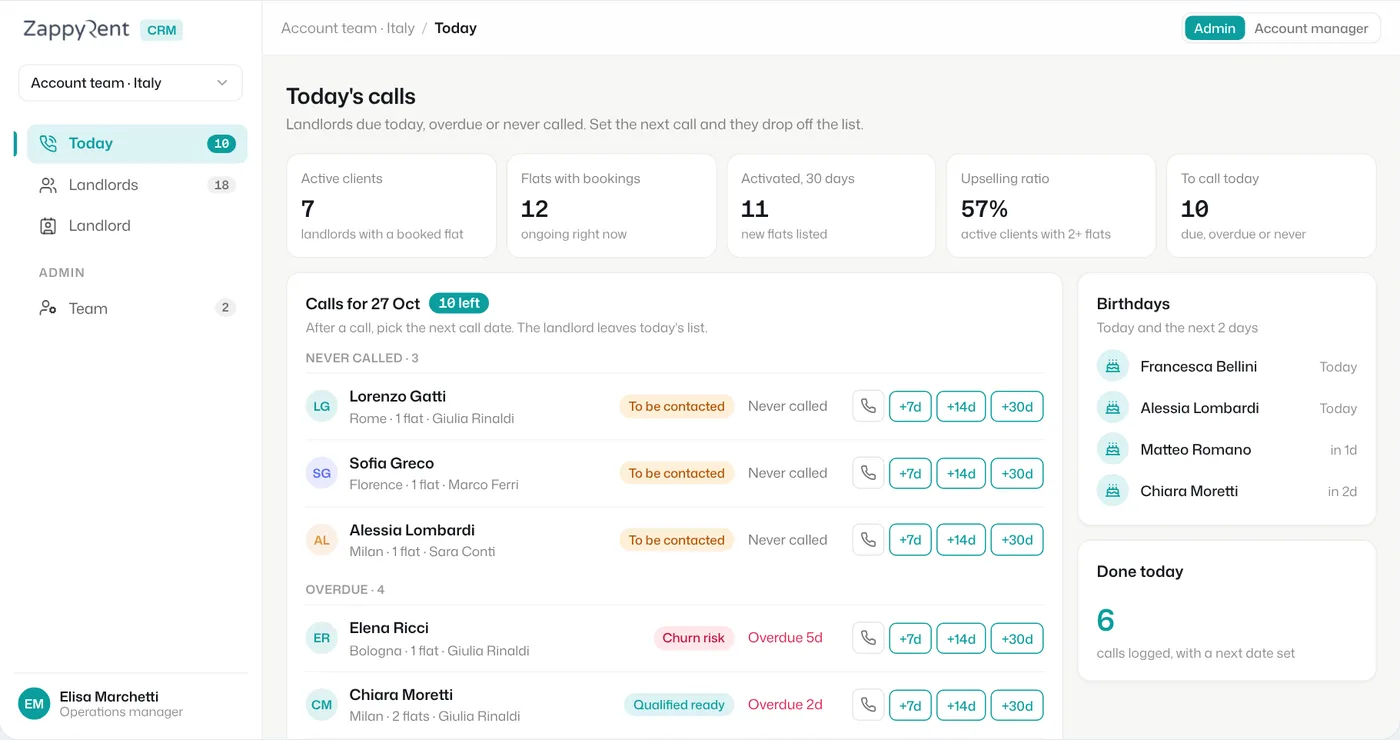
Landlord CRM for Zappyrent's account managers
AI runs on · No AI in this one. Retool on Zappyrent's live PostgreSQL database
Zappyrent, an Italian rental platform, grows by selling more to landlords who already rent through it. Account managers couldn't see who they had called or when to follow up. In about two weeks we built a CRM on the live booking database: a daily call list, KPIs per manager, birthdays, notes and landlord assignment. Each manager sees only their landlords; the operations manager sees everyone.
17 days after handover, the client came back with the spec for a second app.
The first version went to a review call with the COO on 5 September 2023. The feedback changed the spec, and refinements ran until delivery on 22 September. Budget a review round into any CRM build.
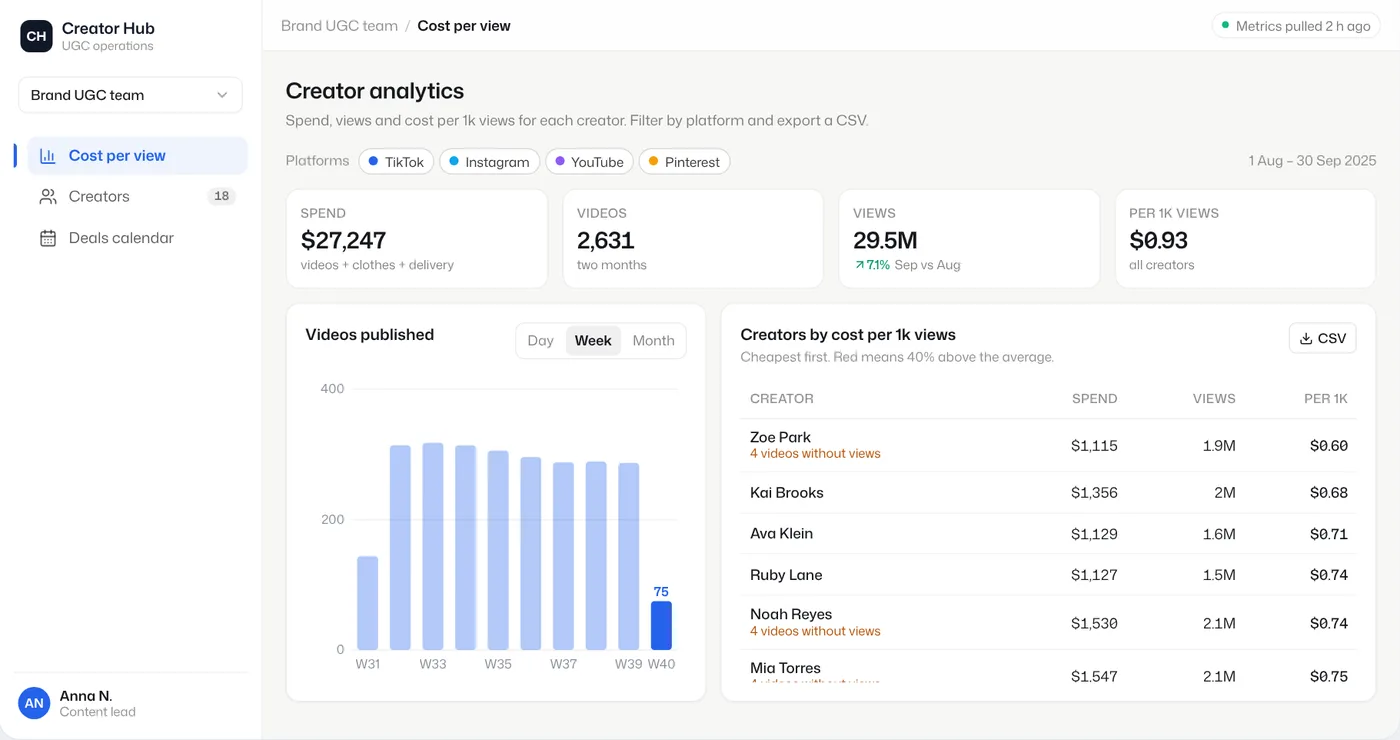
Creator CRM for a clothing brand's UGC team
AI runs on · No AI in this one. A Lovable app on a Postgres-style database, in the client's own workspace
The brand ran its creators through Excel, Notion and a separate database. The spec was written six days after the discovery call, and a working admin was live about two weeks after the first spec. The CRM holds each creator, deals with the true cost (video price, clothes sent, delivery), a content calendar, and cost per view per creator with weekly and monthly summaries. Creators log their own videos in a portal.
This was an MVP, and the case page has no results after launch to report. The metrics refresh from the social platforms was planned, not built, in this version.
What we'd do differently today: all four in code with Claude Code, in the client's own GitHub, Supabase and Vercel. The payments CRM and the landlord CRM had the right shape: a real database under a focused screen. The tools around them were the slow part.
How to build your own CRM with Claude Code
This is the order we work in. It suits a founder with Claude Code and a free afternoon, and it is also what a builder should show you.
- Write down the records and the day. Which things you track (companies, contacts, deals, payments, tasks) and what each person does with them every morning. One page is enough.
- Start from your real data. Export your current CRM, sheet or base. Claude Code reads it and proposes tables and links.
- Database first. Create the tables in Supabase with migrations, so every change is in the repository.
- Roles before screens. Decide who sees what, then enforce it in the database with row-level security. Zappyrent's managers saw only their landlords; that rule belongs in the database, not the page.
- One screen per job. A call list, a pipeline board, a record page. Build the screen people open every morning first.
- Import, then run side by side. Copy the data in, compare counts and a sample of records, and keep the old tool open for a week or two.
- Add scheduled work and AI last. Follow-ups, reminders, syncs and AI steps run as cron jobs with a runs table and an error alert.
- Hand over the keys. The repository, the database and the hosting live in your accounts from day one.
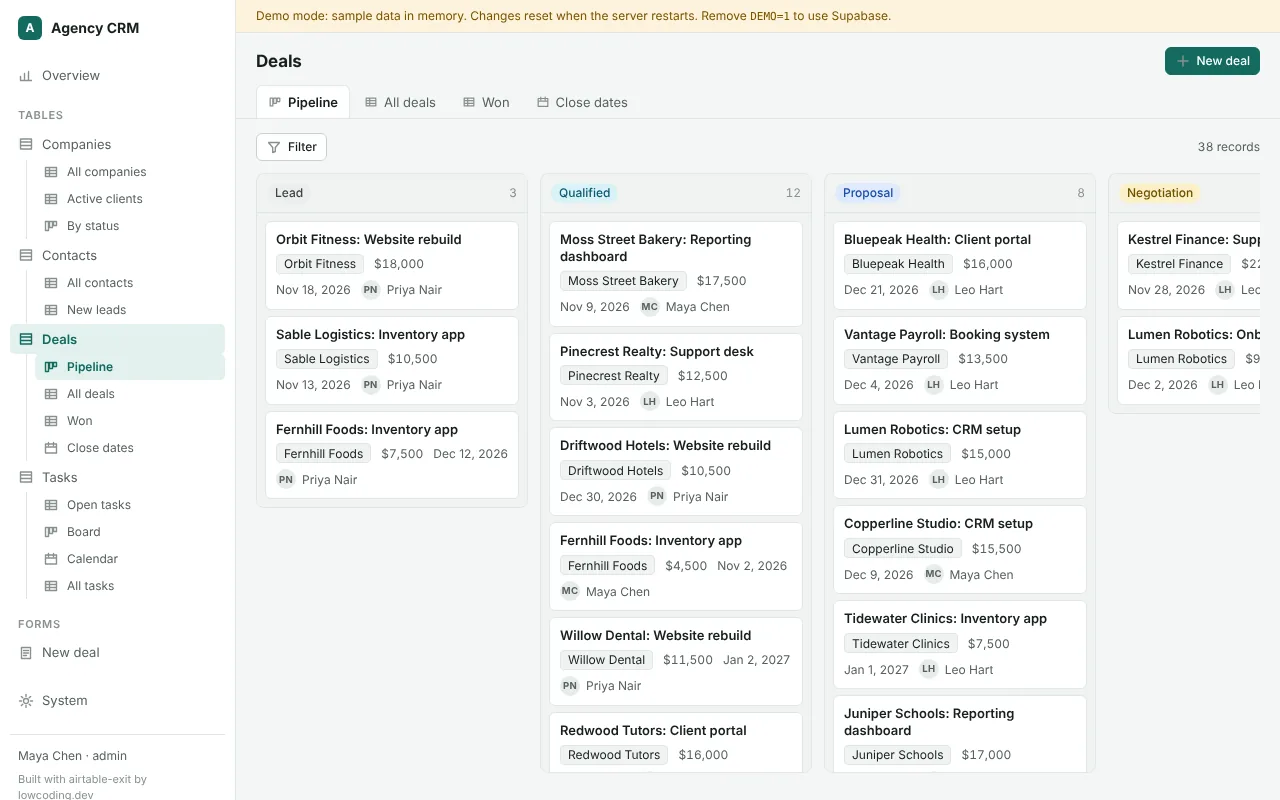
A free starting point: the CRM in airtable-exit
AI runs on · Claude Code builds it; Next.js on Vercel, Supabase and GitHub in your accounts
We packaged the CRM we start from as part of an open-source kit, airtable-exit (MIT). One schema file describes the tables, fields, views, forms and roles, and the app renders them. Sign-in is for invited people only, with roles enforced in Postgres on every table. It was made to move teams off Airtable, but the app works on its own and runs in demo mode with no accounts.
The migration side hasn't run against a live customer Airtable base yet, so it starts read-only and asks before writing. Airtable's API doesn't expose view filters, sorts or rollup functions, so those are guessed and flagged.
When not to build your own CRM
- Your process is a standard sales pipeline. Leads, deals, stages, email. HubSpot, Pipedrive and others have spent years on that. Buy one.
- You need marketing email at scale. Deliverability, consent and unsubscribe handling are a product of their own. Keep a tool for it and connect it.
- Nobody will own it. A custom CRM needs one person who decides what changes and checks it. Without that person it slowly breaks, the way the broker's Monday rules did.
- You need 50 integrations on day one. A bought CRM's marketplace is hard to match. Your own CRM connects to the few tools you really use.
- You can't wait a week. HubSpot Free works today for up to 2 users.
Questions people ask
- How much does it cost to build a custom CRM?
It depends on who builds it. One agency publishes $45,000–100,000 for an MVP in 12–20 weeks (RaftLabs, November 2026). With Claude Code, our first versions start at $1,990 and take about a week, with later stages priced in writing. Hosting on Supabase Pro and Vercel Pro is about $45 a month.
- Is it better to build or buy a CRM?
Buy when your sales process is standard and you want marketing email and integrations ready. Build when the CRM has to run something unusual, such as payments, landlord upsells or creator deals, or when your data already lives in your own database.
- Can Claude Code build a CRM?
Yes. Our funding-broker CRM was written with Claude Code: a Next.js and Supabase app with leads, contacts, a pipeline, sequences and AI reply sorting. Someone still has to decide the data model, check the changes and own the hosting.
- How long does it take to build a CRM?
From our builds: under 3 weeks for the payments CRM, about 2 weeks for the landlord CRM, about 2 weeks from spec to a working admin for the creator CRM, and under 3 weeks to both broker apps running on the client's accounts. Agencies publish 12–20 weeks for an MVP.
- Is HubSpot CRM really free?
HubSpot's free tools cover up to 2 users with no credit card (checked 15 November 2026). Sales Hub Starter is $20 per seat a month, and Professional is $90 per seat billed yearly plus a required $1,500 onboarding.
- What do I need to run my own CRM?
A database (we use Supabase), hosting for the app (we use Vercel), a code repository in your GitHub, and a person who owns it. Supabase and Vercel both have free tiers; for a business we use Supabase Pro at $25 a month and a Vercel Pro seat at $20.
SOURCES
- 1.HubSpot Sales Hub pricing (hubspot.com) · checked 15 November 2026
- 2.CRM development cost (RaftLabs, updated 11 Nov 2026) · checked 15 November 2026
- 3.Supabase pricing (supabase.com) · checked 15 November 2026
- 4.Vercel pricing (vercel.com) · checked 15 November 2026
- 5.Claude plans and pricing (claude.com) · checked 15 November 2026
- 6.airtable-exit: open-source kit and CRM template (GitHub) · checked 15 November 2026
- 7.Case: revenue-ops app for a UK funding broker · checked 15 November 2026
- 8.Case: client and payments CRM for a US legal-services company · checked 15 November 2026
- 9.Case: Zappyrent landlord CRM · checked 15 November 2026
- 10.Case: creator CRM for a clothing brand · checked 15 November 2026
Drafted with Claude from our project records; checked and edited by Mark.