Claude for small business: what it can run for you in 2026, with 6 systems we built

- Published
- 15 November 2026
- Prices checked
- 15 November 2026
Claude can run the reading and writing work of a small business: sorting replies, scoring calls, drafting reports, and building the internal tools around them. A team starts on the Team plan at $20 to $25 per seat a month, with Anthropic's Small Business plugin in Cowork. Jobs that run daily without anyone clicking need Claude inside a small app.
Four ways to use Claude in a small business, and what each costs
| Way to use it | What it runs for you | Who presses the button | Price, checked 15 Nov 2026 | From our builds |
|---|---|---|---|---|
| Chat and Projects | Drafts, summaries, long contracts and reports, answers from your own files | You, every time | Free $0. Pro $17 a month billed yearly, or $20 monthly | Before the build, Atlas People's managers wrote each report in a chat window (ChatGPT): 3–5 hours a report |
| Cowork with the Small Business plugin | Month-end close, payroll planning, unpaid invoices, lead follow-up in QuickBooks, HubSpot, PayPal and other tools | Claude does the steps; you approve before anything is sent, posted or paid | Included in Pro, Max, Team and Enterprise. Team $20–25 per seat a month | Not run for a client yet; see the plugin section below |
| Claude Code | Builds the tool itself: a CRM, a portal, a dashboard, the automation | A builder, with you reviewing | Included from Pro. Heavy use: Max $100 or Ultra $200 a month | UK funding broker: two apps on the client's accounts in under 3 weeks |
| Claude API inside your app | The same reading job on every record: every reply, every call, every report | Nobody. It runs on a schedule or a trigger | Per million tokens in / out: Haiku 5.5 $0.10 / $0.50, Sonnet 5.5 $2 / $10 | Tala: Claude agents build the video pipelines; 4,000+ videos made |
Swipe the table sideways for all columns. Prices from claude.com/pricing and claude.com/product/cowork, last checked 15 November 2026. Team prices are per seat (2–150 seats). The Haiku price is for prompts up to 100K tokens.
Most small businesses need the first two rows. The last two matter when one job repeats hundreds of times a month and someone has to do it the same way each time. That is where the six systems below sit.
A plain rule before any of this: Claude reads and writes. It is good at turning messy text into a clear answer, and at writing code. It does not make photos, and it is the wrong tool for a fixed rule a spreadsheet formula already handles. Both limits are covered in When not to use Claude.
Claude plans and prices for a small team in 2026
| Plan | Price | Who it fits | Worth knowing |
|---|---|---|---|
| Free | $0 | Trying it on your own work | Limited use every 5 hours and every week |
| Pro | $17 a month billed yearly ($200 up front), or $20 monthly | One owner or one key person | Includes Claude Code and Cowork |
| Max | $100 a month | One person who uses it all day | 5× Pro usage, plus $100 a month in API credits |
| Ultra | $200 a month | Long build or research sessions | No 5-hour limit, 10× Pro usage a week, $200 in API credits |
| Team, standard seat | $20 per seat a month billed yearly, or $25 monthly | 2 to 150 people sharing projects | Claude Code and Cowork, admin and SSO, no training on your content by default |
| Team, premium seat | $100 per seat a month billed yearly, or $125 monthly | The heavy users inside a team | 5× the usage of a standard seat; seat types can be mixed |
| Enterprise | $20 per seat a month billed yearly, plus usage at API rates | Larger firms | 20-seat minimum, audit logs, SCIM, spend limits |
Swipe the table sideways for all columns. All prices in US dollars as published on claude.com/pricing, last checked 15 November 2026. Usage limits depend on the model and the length of your chats.
For a team of five on standard seats, that is $100 a month billed yearly or $125 billed monthly. Give the one person who lives in it all day a premium seat and keep the rest on standard.
The API is billed separately, per token. It is what a system uses when it runs on its own, and the bill follows the volume. Our cost-per-item numbers below come from our own builds: about $0.138 per kitchen render, under $3 per Atlas People report, about £0.18 of data cost per qualified lead for the broker. Each one was measured on the model that system runs on.
What Anthropic's Claude for Small Business actually is
Anthropic launched Claude for Small Business on 13 May 2026. It is a plugin you install inside Cowork, Claude's mode for multi-step work across your files and tools. On 15 November 2026 its page listed 43 ready-to-run workflows and 37 partner connectors, up from the 15 workflows and 15 skills in the launch post.
The named connectors include QuickBooks, PayPal, HubSpot, Shopify, Salesforce, Gusto, Square, Stripe, Xero, Canva, Docusign, Google Workspace, Microsoft 365, Slack and Zapier. Connectors are optional: you can upload a spreadsheet or a bank statement instead.
The workflows have plain names:
- Run the business: /monday-brief, /close-month, /plan-payroll, /pay-the-bills, /restock, /tax-prep
- Grow the business: /speed-to-lead, /grow-pipeline, /call-list, /marketing-monday
- Make it yours: /smb-onboard, plus tools to build your own connector or agent
Every workflow starts in approval mode. Nothing is sent, posted or paid until you say yes. The page lists no separate price; it runs in Cowork, which comes with every paid plan.
The plugin works inside the tools you already pay for, with a person approving each step. That covers a lot of a small business. It stops short of three things: a shared database with a screen your team works in, a record of every decision with its evidence, and the same check on thousands of records. Those are the jobs we build.
6 systems we built, and which model does the AI work
Three of these use Claude: Claude agents at the core of one, Claude Code as the way we built two others. Three were built in 2024–25 on OpenAI models. We name the model for each. Every one of these jobs is the same shape: read text, return a structured answer with its evidence. That is a job Claude's API does too.
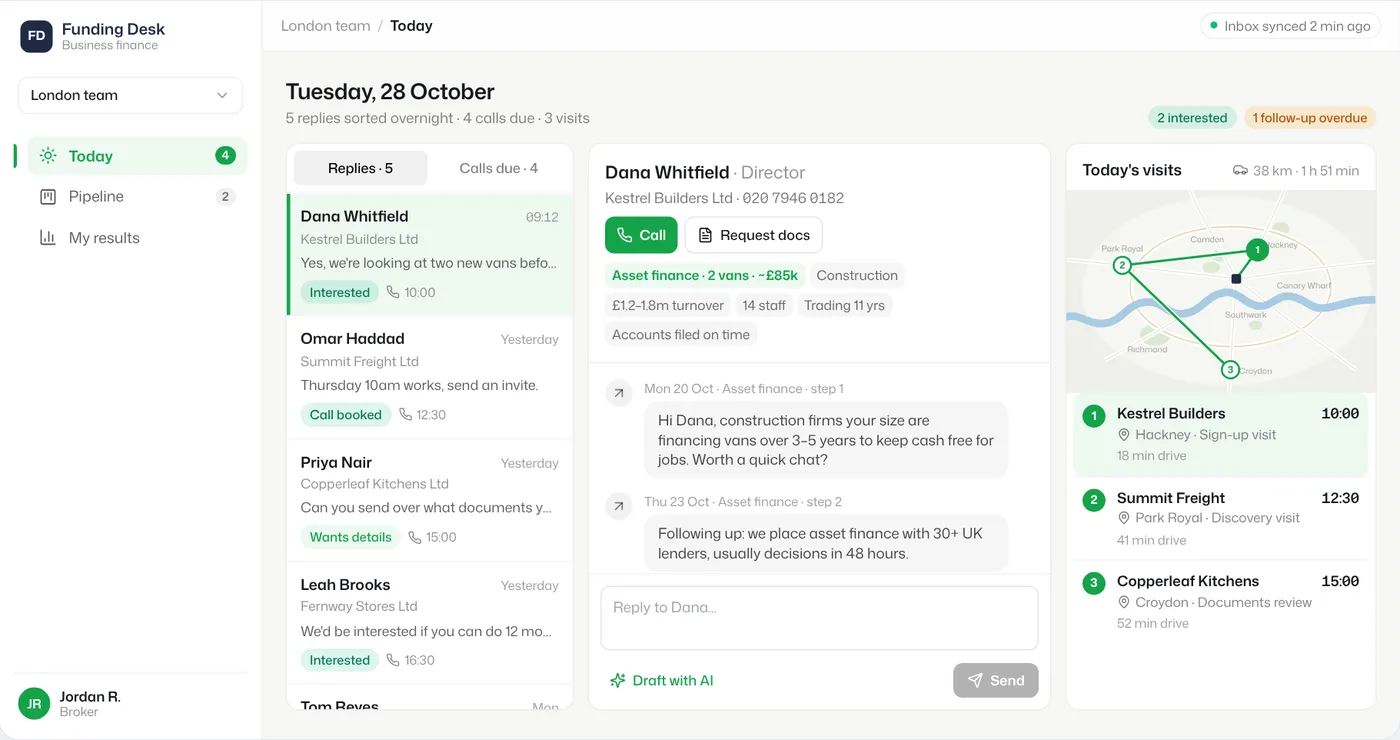
Lead engine and reply sorting for a UK funding broker
AI runs on · Built with Claude Code. Next.js and Supabase app on the client's own Vercel account
The broker had no repeatable way to find UK businesses that need funding. We built a waterfall over public-register data that filters and enriches each company, at about £0.18 of data cost per qualified lead; 72% of the qualified leads have an email.
Outreach replies flow back into one app. An AI step sorts each reply into one of 8 intents and matches it to the contact: 90% are matched with nobody touching them. Both apps were running on the client's own accounts less than 3 weeks after the broker side was onboarded.
The Monday.com board looked automated but wasn't. 32 follow-up rules had stopped firing in July, 498 follow-ups were more than 30 days overdue, and the next follow-up date had been typed by hand 187 times. We audited all 32 and rebuilt the 12 that mattered.
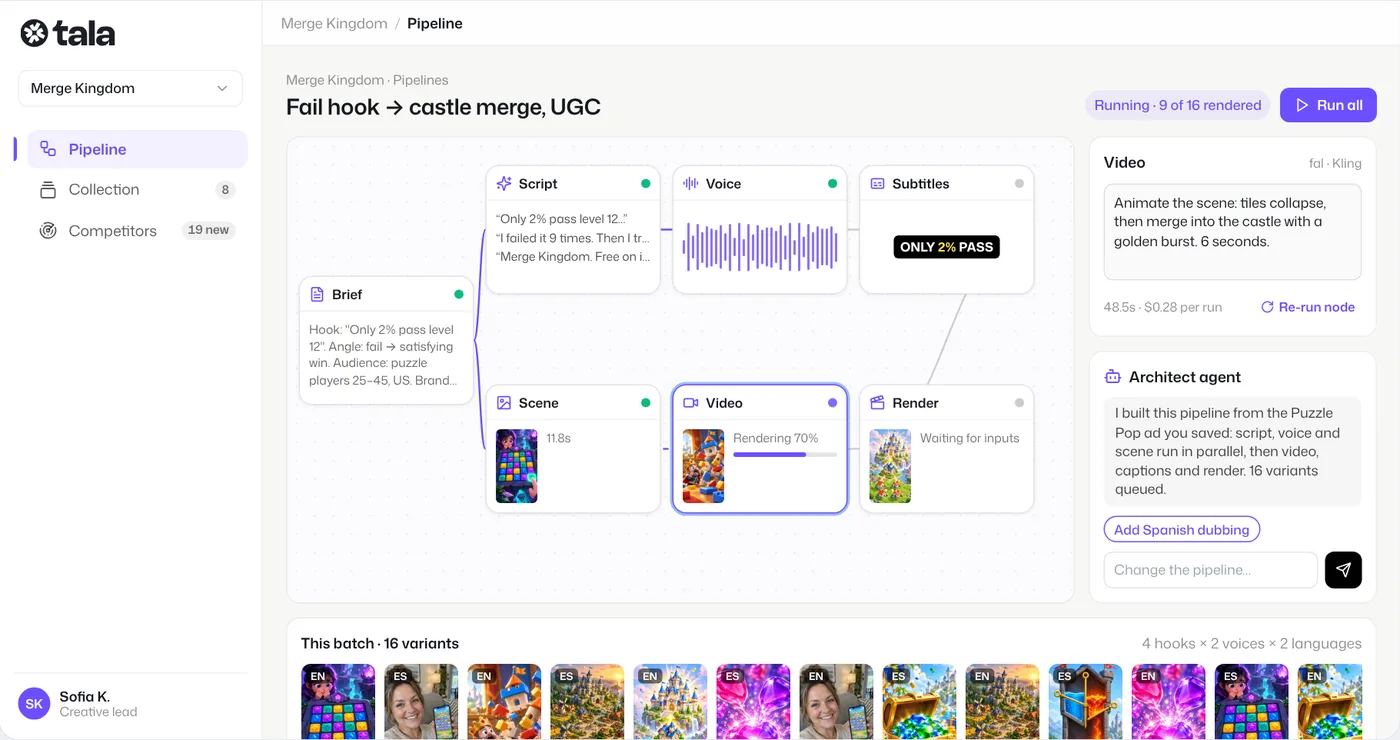
Agents that build ad-video pipelines
AI runs on · Anthropic Claude agents, with fal.ai video models, Gemini and ElevenLabs
Built while Mark was Tala's co-founder and CPO. A main Claude agent works with architect, editor, animator and playable agents. The architect reads a brief, designs the node pipeline and wires it itself. One ad concept turns into many variants in parallel, so 20 variants take as long as one. Customers reported a batch of creatives going from 3 days to one morning.
Generative video is slow and brittle. Clips take minutes to render, providers fail, and models cap a clip at 10–15 seconds. The orchestration had to retry, skip steps that had already finished, and check credits before spending them.
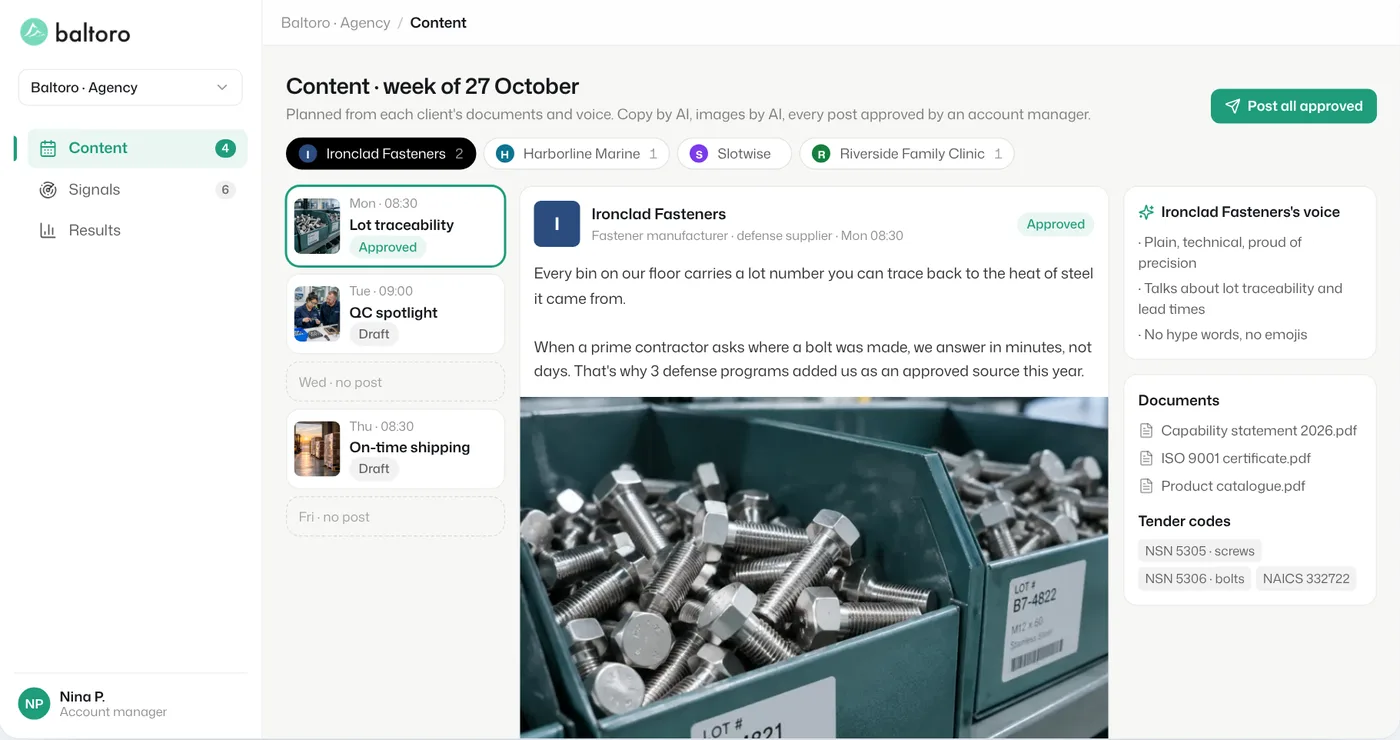
An AI platform for a Chicago marketing agency
AI runs on · OpenAI and Gemini for writing and images. Built with Lovable, Supabase, n8n and Claude Code
It started as a LinkedIn post generator, shipped in 30 days. It grew into the agency's internal platform: content in each client's voice, a weekly government-tender hunter for 6 clients, news-trigger leads and a client portal. 22 agency clients use its internal marketing chatbot.
The tender file was a 70,000-row CSV. n8n crashed on it and Make hung, so someone cleaned it by hand. A separate pre-filter tool now cuts it to about 500 relevant tenders.
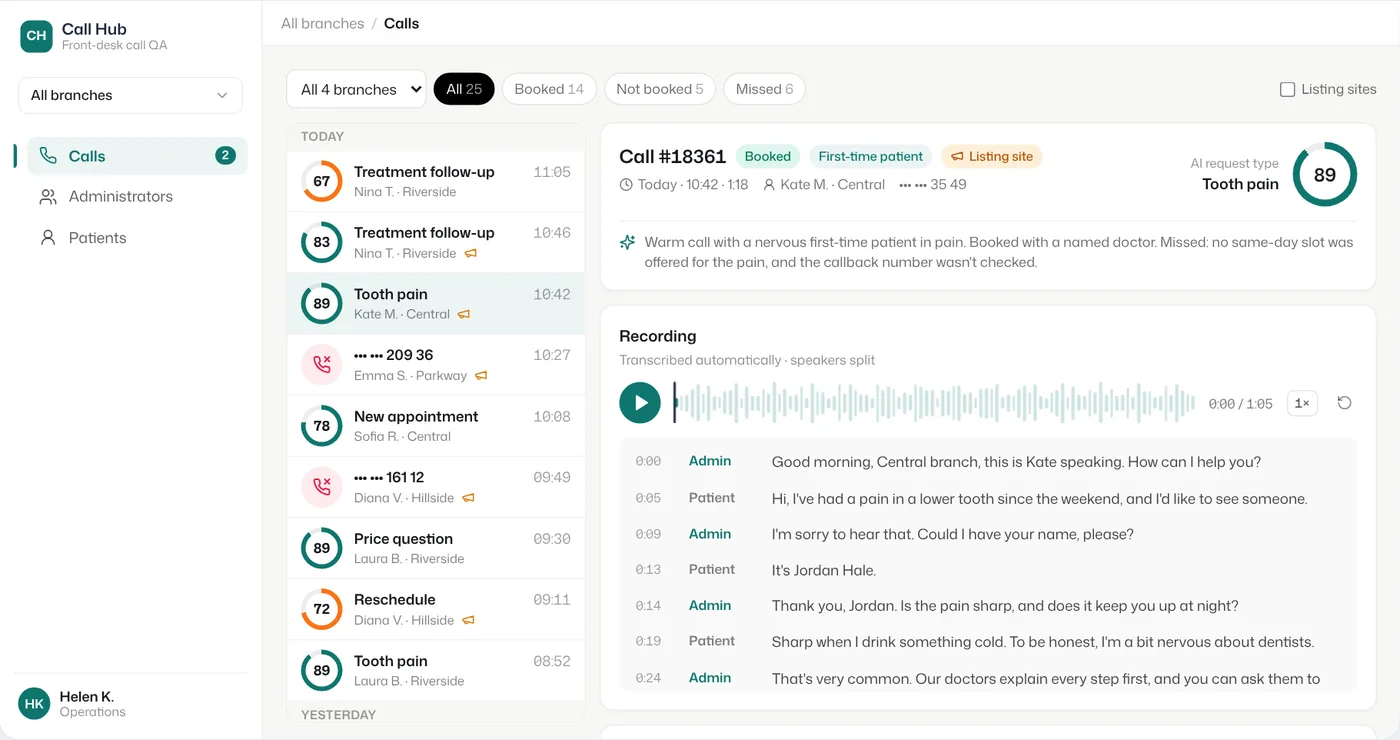
Front-desk call scoring for a four-branch dental network
AI runs on · OpenAI GPT for scoring, speech-to-text AI for transcripts, n8n and Supabase
Every call from four branches, missed ones included, is pulled from the telephony system, transcribed and scored on 18 criteria: the greeting, the patient's situation, their fears, the treatment offered, the booking. The prompt may only return verbatim quotes as evidence, so a manager can check every mark.
A Call Hub dashboard shows each call, each administrator and each patient's history, with pages loading in 20–40 ms. It has been in daily use for about 2 years.
The telephony API only answers requests from inside its own region, so the pipeline couldn't reach it. A small relay server fixed that. Calls from doctor-listing sites were mixed in with the rest; they now get a badge, so the clinic sees what those sites bring in.
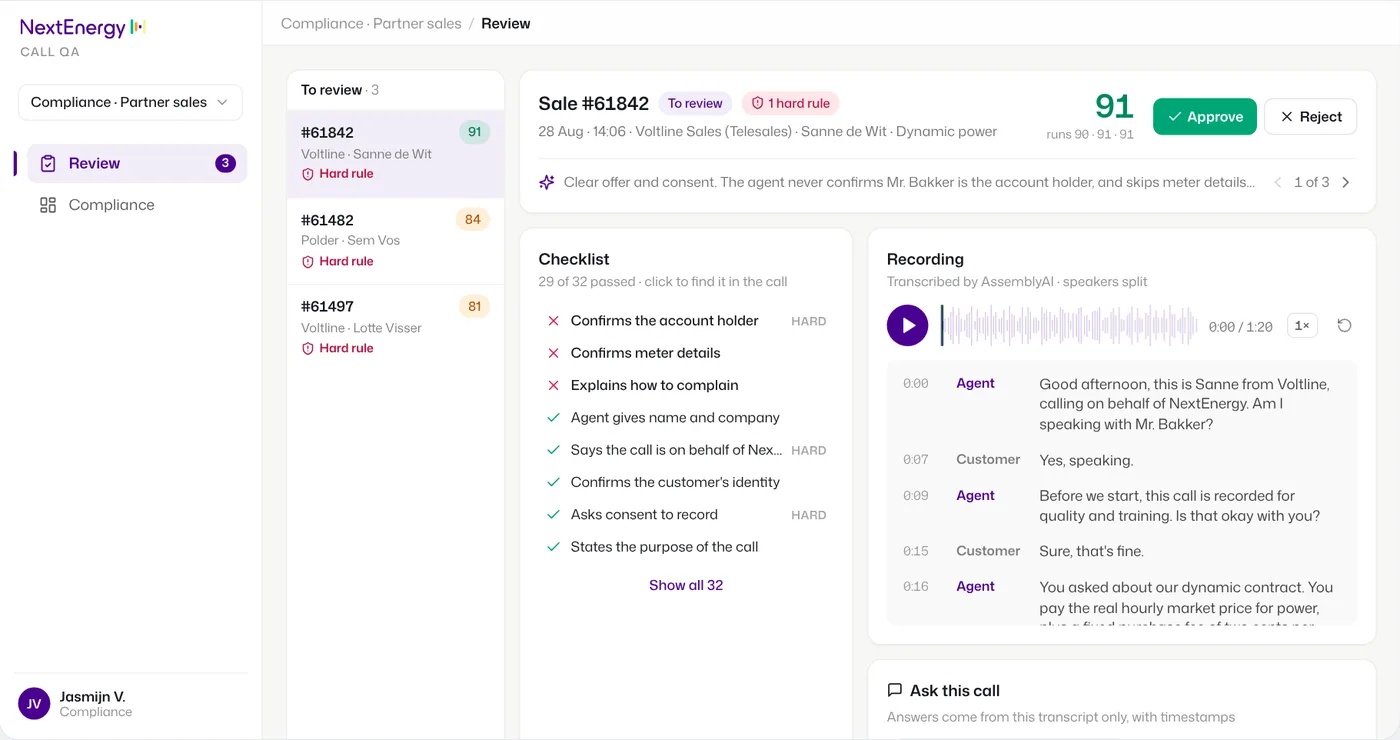
Compliance checks on every sales call for an energy supplier
AI runs on · AssemblyAI for transcripts, OpenAI for the checks, with n8n, Supabase and Lovable
NextEnergy, a Utrecht energy supplier, sells partly through outside telesales and door-to-door partners, and every sale has to meet Dutch compliance rules. Partners upload recordings to FTP. The pipeline picks them up, adds the sale details from Salesdock, transcribes each call and checks it. A dashboard compares partners and agents over time. The pipeline and the web app took 70 hours to build.
The flow it replaced asked the model for one score per call, and scores could jump from 60 to 85 with no clear reason. We split the score into 30+ yes/no questions and repeat the checks for consistency. The lesson holds for any model, Claude included: ask many narrow questions, then add them up.
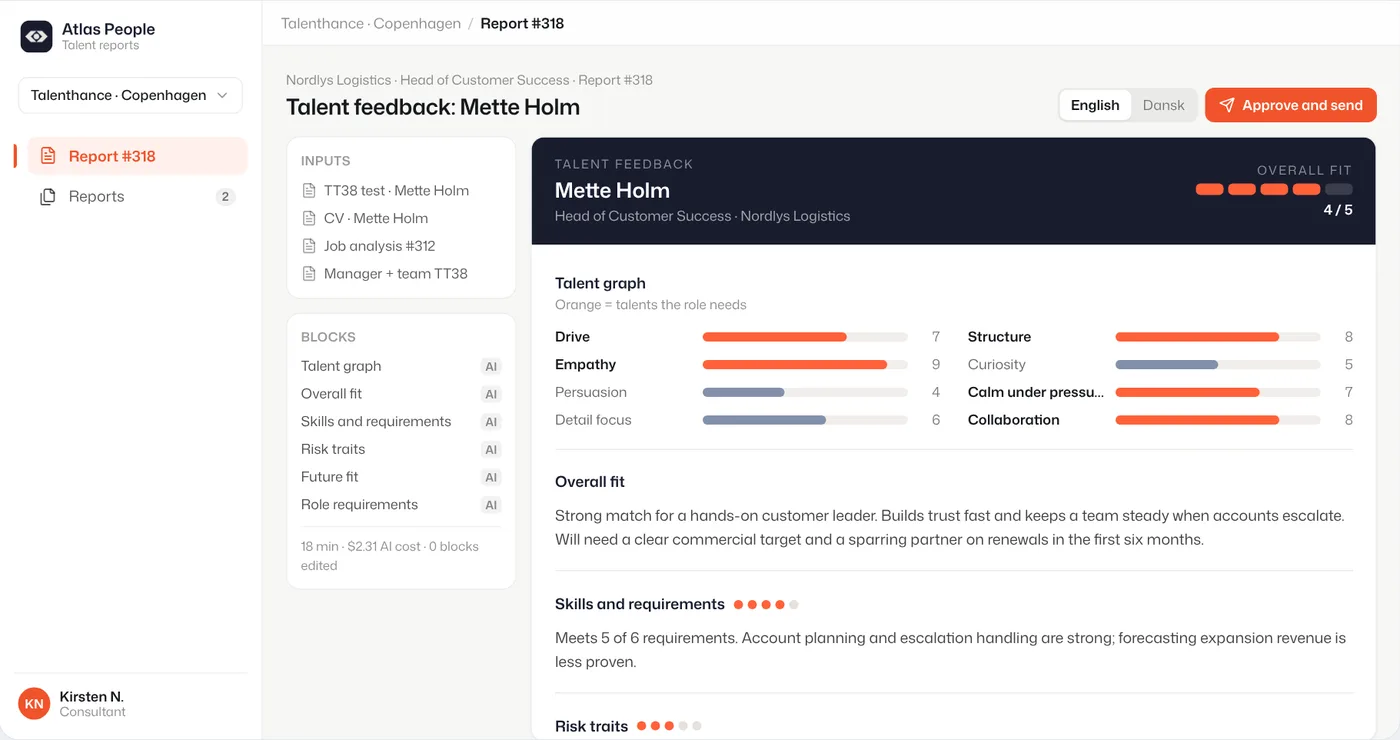
Talent reports in 20 minutes for a leadership-assessment firm
AI runs on · OpenAI, with Lovable, Supabase and n8n
Atlas People, in Copenhagen, assesses leaders against a client's strategy and roles. Managers wrote each job analysis and candidate report by hand in ChatGPT, from heavy inputs: role notes, top-performer profiles and psychometric test PDFs.
We built a form-and-prompt engine. Each report section has its own prompt and output schema, admins edit the prompts, and a new report type needs no new code. Reports export to PDF in any language.
Tested by hand, the model invented talents, mixed Danish and English, and filled sections that had no input behind them. The fix was guardrails in the system: fixed talent lists, a language selector, and an empty section when there is no input.
When not to use Claude for this
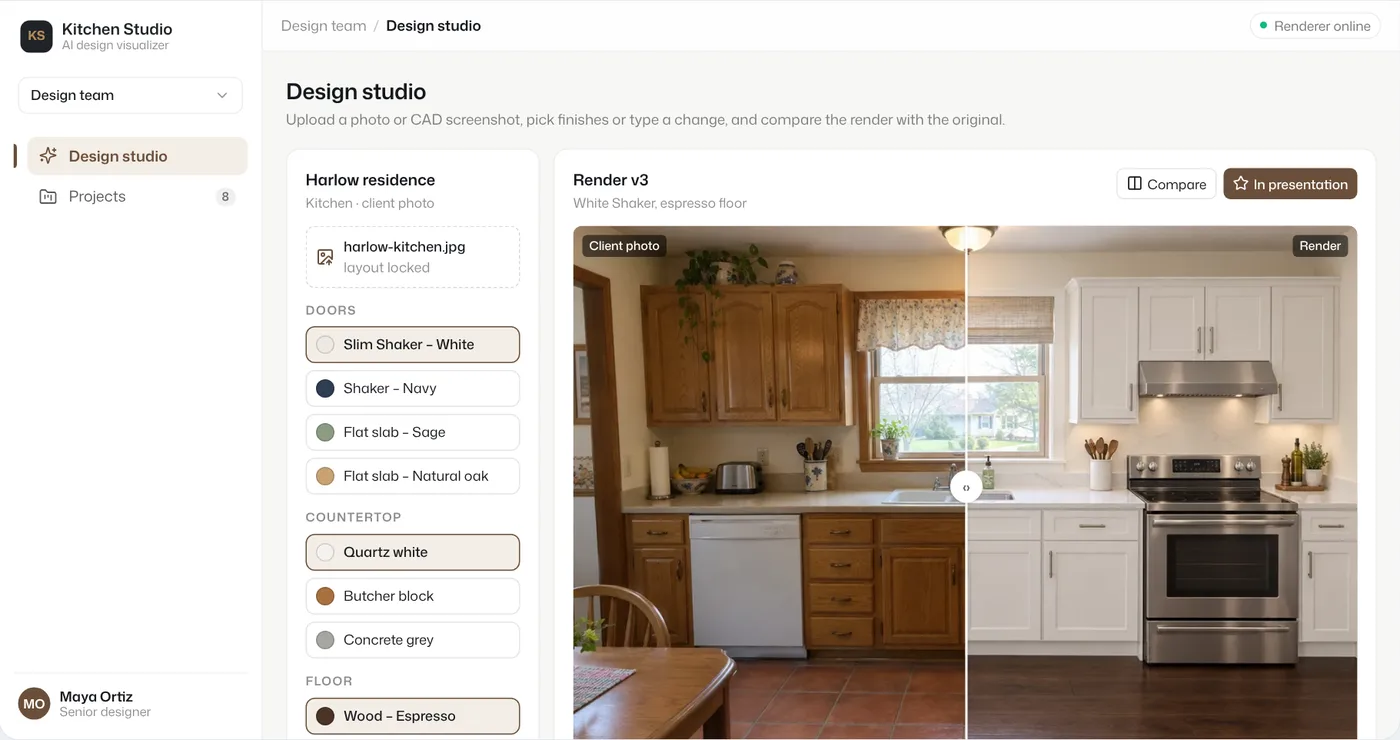
- You need pictures. Claude doesn't make photos or illustrations (Anthropic's help page). Our kitchen visualizer turns a homeowner's photo into a realistic render with Gemini 3 Pro Image: 3,962 renders by the firm's own designers, at about $0.138 each.
- The rule is fixed. "When the invoice is paid, mark the deal won" needs no model. Plain code or your tool's own automation does it the same way every time, for nothing.
- The volume is tiny. If the front desk takes 20 calls a week, a manager can listen to them. The dental build paid off at 1,200 calls a month.
- Nobody will check the output. Every system above shows its evidence: a quote from the call, the matched contact, the criterion that failed. If nobody will look, don't hand the decision to a model.
- The data can't leave your systems. Check your contracts and your industry's rules first. Anthropic says Team and Enterprise don't train on your content by default. That is a starting point; your own compliance check still comes first.
When chat and Cowork stop being enough
Four signs the job has outgrown a chat window:
- It has to run when nobody is at a laptop: every call, every reply, overnight.
- More than one person needs the same result in one place, each with a login.
- You need a record of every decision: who, what, when, and the evidence.
- The data is too big for a chat: a 70,000-row tender file, 57,291 companies from a register.
At that point you need a small app: a database (we use Supabase), a screen your team works in, and Claude's API doing the reading. We build these with Claude Code, which is why a working version takes about a week. It runs in your accounts and you own it.
How to start this week
- Pick one job that repeats every week and has a clear right answer: sorting replies, checking calls against a script, chasing unpaid invoices.
- Collect 20 real examples and write down the answer a good employee would give for each.
- Run them through Claude chat on Pro. Count how many it gets right, and note the misses.
- If the job lives in QuickBooks, HubSpot or PayPal, try the Small Business plugin in Cowork on the same examples, in approval mode.
- If it has to run on every record without anyone clicking, it's a build. Your 20 examples become its first test set.
Questions people ask
- Is Claude good for small business?
Yes, for work that is mostly reading and writing: email, proposals, reports, contracts, call transcripts, and the code for internal tools. It is the wrong tool for images and for fixed rules a formula already handles. Start with one repeating job and test it on 20 real examples before you pay for seats.
- How much does Claude cost for a small business?
On 15 November 2026: Pro is $17 a month billed yearly or $20 monthly for one person. The Team plan is $20 per seat a month billed yearly or $25 monthly, for 2 to 150 people; premium seats are $100 or $125. A team of five on standard seats pays $100–125 a month. API use inside your own systems is billed per token on top.
- What is Claude for Small Business, and is it free?
It is Anthropic's plugin for Cowork, launched on 13 May 2026: ready-made workflows for bookkeeping, payroll planning, invoices, leads and marketing, connected to tools like QuickBooks, PayPal and HubSpot. The plugin page lists no separate price. You need a paid Claude plan that includes Cowork: Pro, Max, Team or Enterprise.
- Is Claude or ChatGPT better for a small business?
It depends on the job, and we use both. Of the six systems in this post, three use Claude and three run on OpenAI models. We build with Claude Code, and Tala's agents run on Claude. For photos we use an image model: our kitchen visualizer runs on Gemini's.
- Does Claude use my business data for training?
Anthropic's pricing page says Team and Enterprise plans don't train models on your content by default. On Free, Pro and Max, check the privacy settings in your account. Either way, check your client contracts before you upload client data.
- Can Claude make images for my marketing?
No. Anthropic's help page says Claude doesn't generate photos or illustrations. It can build charts, diagrams and layouts from code, write the prompts for an image model, and review the images that come back.
- Do I need a developer to use Claude?
Not for chat, Projects or Cowork. Claude Code lets a non-developer build a simple internal tool. Anything that holds customer data, has several users or must run every day needs someone to check security, logins and backups before real people rely on it.
SOURCES
- 1.Claude plans and pricing (claude.com) · checked 15 November 2026
- 2.Claude Cowork: plans that include it (claude.com) · checked 15 November 2026
- 3.Introducing Claude for Small Business (Anthropic, 13 May 2026) · checked 15 November 2026
- 4.Small Business plugin: workflows and connectors (claude.com) · checked 15 November 2026
- 5.Can Claude produce images? (Claude Help Center) · checked 15 November 2026
- 6.Case: lead engine and revenue-ops app for a UK funding broker · checked 15 November 2026
- 7.Case: Tala, AI ad creative platform · checked 15 November 2026
- 8.Case: Baltoro, AI platform for a Chicago agency · checked 15 November 2026
- 9.Case: front-desk call QA for a dental clinic network · checked 15 November 2026
- 10.Case: NextEnergy call compliance scoring · checked 15 November 2026
- 11.Case: Atlas People talent reports · checked 15 November 2026
- 12.Case: AI kitchen visualizer for a US design firm · checked 15 November 2026
Drafted with Claude from our project records; checked and edited by Mark.