Claude chat vs Cowork vs Claude Code: which one a business owner should use

- Published
- 15 November 2026
- Prices checked
- 15 November 2026
Use Claude chat for one-off questions and drafts. Use Cowork when Claude should do a multi-step job across your files and tools while you approve the steps. Use Claude Code when you want a tool built, or a job that runs from code without you. All three come with Pro, from $17 a month; Free has no Claude Code.
Chat, Cowork and Claude Code side by side
| Claude chat | Cowork | Claude Code | |
|---|---|---|---|
| Built for | Questions, drafts, reading long documents | Multi-step office work: reports, research, files, tools | Software: reading, writing and running code |
| What it touches | What you paste or upload, plus connected apps | Folders and tools you choose, a built-in browser, your screen if it must | A code project, its terminal, Git and the services the code calls |
| Who presses the button | You, every message | You hand off the job and approve big steps; it can run on a schedule | A builder directs it; the code it writes can then run with nobody watching |
| Where it runs | Web, desktop and mobile | Web and mobile; the desktop app adds your own folders and apps | Terminal, VS Code, JetBrains, the desktop app, web, mobile and Slack |
| Plans, checked 15 Nov 2026 | Free and every paid plan | Pro, Max, Ultra, Team and Enterprise | Pro, Max, Ultra, Team, Enterprise, or pay per token through the API |
| A good first job | Rewrite a tricky customer email | Build next week's report from a folder of spreadsheets | Build a small app your team logs into |
| Where it stops | Nothing runs unless you type | Works as you, inside your tools; no shared app or database for the team | Someone has to own the code: security, logins, backups |
Swipe the table sideways for all columns. From Anthropic's pages: claude.com/pricing, claude.com/product/cowork and claude.com/product/claude-code, last checked 15 November 2026. Anthropic is folding Cowork into the main Claude app, so the line between chat and Cowork may move.
The short rule: chat answers, Cowork does, Claude Code builds. Most owners need chat every day and Cowork for the weekly chores. Claude Code is for the moment one job repeats hundreds of times a month, or your team needs a screen of its own.
We work in Claude Code every day and build client systems with it. We haven't run Cowork for a client yet, so the Cowork parts below come from Anthropic's own pages, read on 15 November 2026.
One model, three ways of working
All three use the same Claude models. What changes is how much Claude is allowed to do on its own, and where.
Anthropic describes Cowork as using "the same agentic approach as Claude Code" for non-coding work: research, analysis, documents and other multi-step tasks. Claude Code points the same approach at software. Chat is the conversation you already know.
They also share one allowance. On Team and Enterprise plans, Anthropic's cost docs say each person's Claude Code usage draws from a seat allowance "shared with Claude chat and Cowork", reset on a five-hour window and a weekly window. A heavy morning in Claude Code leaves less for chat that afternoon. The Cowork page adds that Cowork "consumes limits faster than Chat", because an agent reads and acts in many steps where a chat answers once.
Paying for one of them gets you all three.
Claude chat: when a conversation is enough
Chat is the right tool when you are in the loop for every step anyway. Good fits:
- Drafting and rewriting: emails, proposals, job posts, policies.
- Reading something long: a contract, a tender, a 60-page report, with questions back and forth.
- Projects: a shared folder of files and instructions, so you stop pasting the same context every time.
The Free plan covers chat with web search, file creation, memory and connected apps, with limited usage every five hours and every week, and up to 5 Projects. Pro lifts the Project cap and adds more usage and more models.
We use chat-side output daily in one form: our plans, reports and research summaries are handed over as pages to read, not as raw files. That is still chat. A person reads, decides and replies.
Where chat stops: nothing happens unless someone types. If the same prompt gets pasted every Monday, or the answer has to land in another tool, the job has outgrown chat.
From a chat window to a report engine
AI runs on · OpenAI, with Lovable, Supabase and n8n
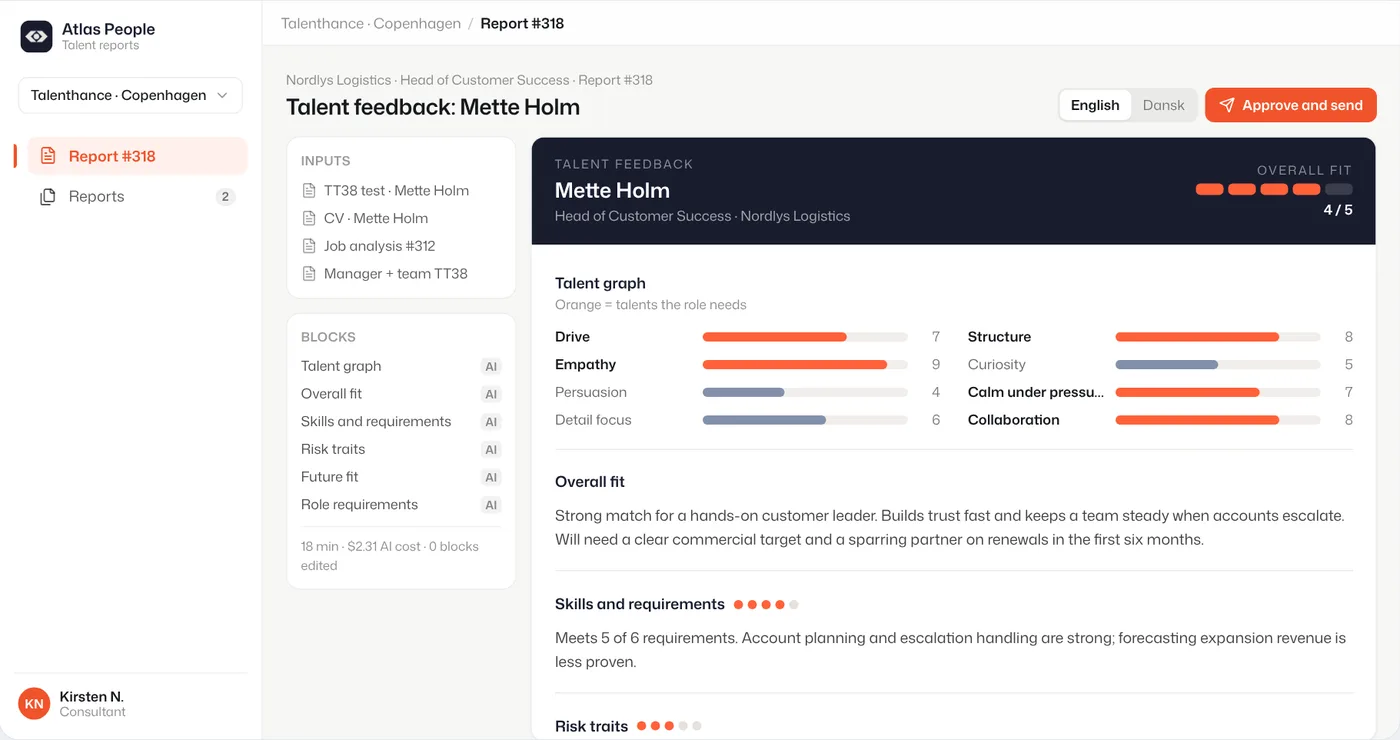
Atlas People's managers wrote each job analysis and candidate report by hand in a chat window (ChatGPT), from role notes, top-performer profiles and psychometric test PDFs. That is chat at its limit: the same long job, done again for every candidate.
We built a form-and-prompt engine. Each report section has its own prompt and output schema, admins edit the prompts, and reports export to PDF in any language. The shape of the job is the same in Claude.
Tested by hand, the model invented talents, mixed Danish and English, and filled sections that had no input behind them. The fix was guardrails in the system: fixed talent lists, a language selector, and an empty section when there is no input. A chat window has none of those.
Cowork: when you want the job done across your files and tools
Cowork is Claude doing a multi-step job for you, in the folders and tools you choose. On its product page, Anthropic lists what it can do:
- Work directly in your files and apps and hand back finished work for review.
- Split a large job into parts that run at the same time.
- Open its own browser in a side panel, separate from your logins, for web tasks.
- Take over your screen only when it has to, asking before each app.
- Run scheduled tasks daily, weekly or monthly, which keep going after you close the laptop.
You stay in charge. With permission settings on, Claude shows its plan and waits for your OK before significant actions, and deleting anything needs your approval. Plugins bundle skills, connectors and sub-agents into one install. Anthropic's Small Business plugin is the best-known one: ready-made workflows for month-end close, payroll planning, unpaid invoices and lead follow-up in tools like QuickBooks, PayPal and HubSpot. We cover it in Claude for small business.
Good Cowork jobs for an owner: a weekly report built from a folder of exports, research across 20 competitor websites into one table, or chasing unpaid invoices with you approving every email.
Claude Code: when you want something built, or a job that runs without you
Claude Code reads a code project, writes and edits files, runs commands and tests, and works with Git. It runs on macOS, Linux and Windows: in a terminal, in VS Code and JetBrains, in the Claude desktop app, on the web, on mobile and in Slack.
The output is the difference. Chat gives you an answer and Cowork gives you a finished file. Claude Code gives you software: an app, an automation, a dashboard, which keeps running after the session ends.
Here is what that looks like in our own work:
- Client apps. The UK funding broker's lead engine and revenue-ops app were built in Claude Code (below).
- Our own systems. The job engine built to pull roles from about 25 sources on a daily schedule, and the portal that scores news feeds every night, are Next.js apps on scheduled jobs, built and maintained in Claude Code sessions.
- Scheduled research. A scheduled Claude Code task runs every weekday morning to find and check new leads. Its goal is 40 sendable leads a day; on 12 November it delivered 28, and the miss went into the run log.
- This website. lowcoding.dev and this blog are built and edited in Claude Code.
Lead engine and revenue-ops app for a UK funding broker
AI runs on · Built with Claude Code. Next.js and Supabase app on the client's own Vercel account
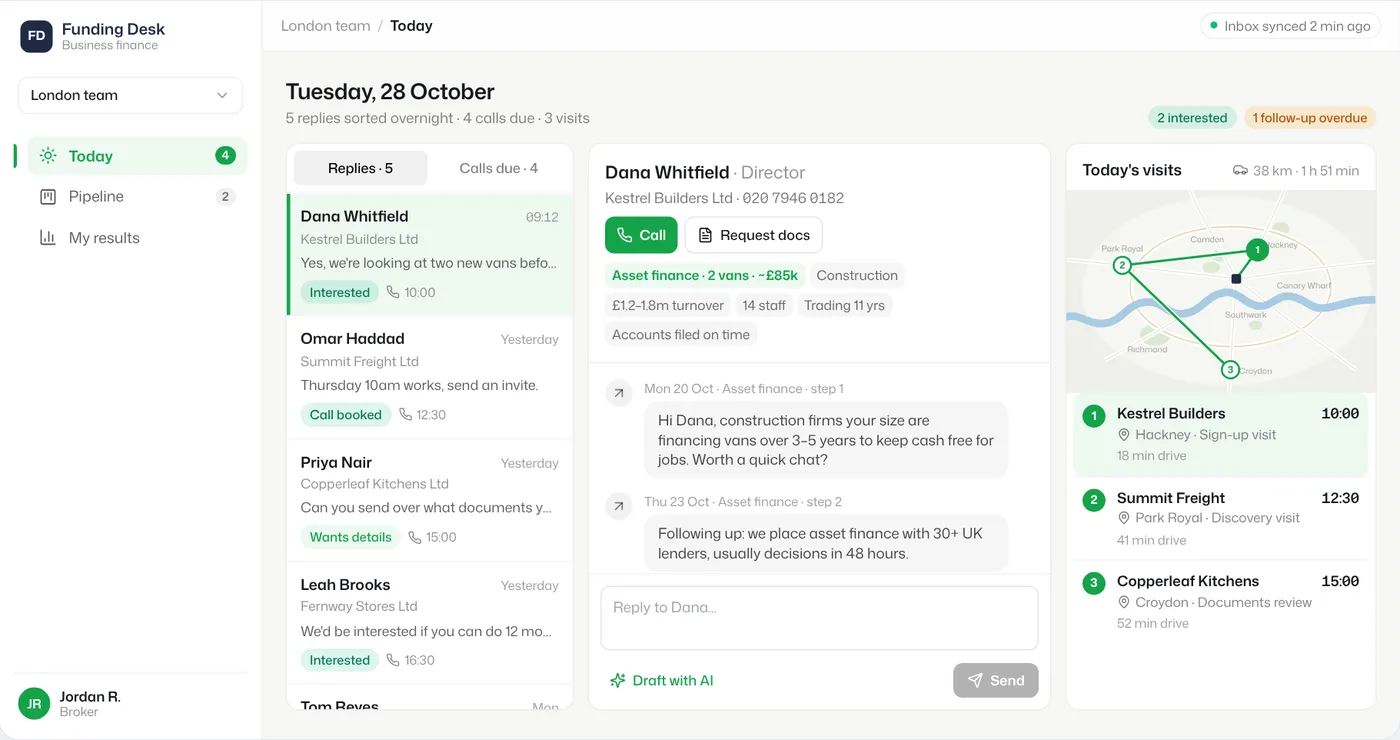
The broker had no repeatable way to find UK businesses that need funding, and outreach replies were matched to contacts by hand. We built a waterfall over public-register data that turned 57,291 raw companies into 14,620 qualified leads, and one app where outreach replies land. An AI step sorts each reply into one of 8 intents; 90% are matched to the right contact with nobody touching them.
No chat window or Cowork run could hold this. The team logs in every day, the data lives in a database, and the sorting runs on every reply.
The Monday.com board looked automated but wasn't. 32 follow-up rules had stopped firing in July, 498 follow-ups were more than 30 days overdue, and the next follow-up date had been typed by hand 187 times. We audited all 32 and rebuilt the 12 that mattered.
The fourth option nobody lists: Claude inside your app
Chat, Cowork and Claude Code all need a person to start them. Some jobs need no person at all: every new reply sorted, every call scored, every report drafted the moment its data arrives. That is the Claude API, called from your own app or pipeline and billed per token.
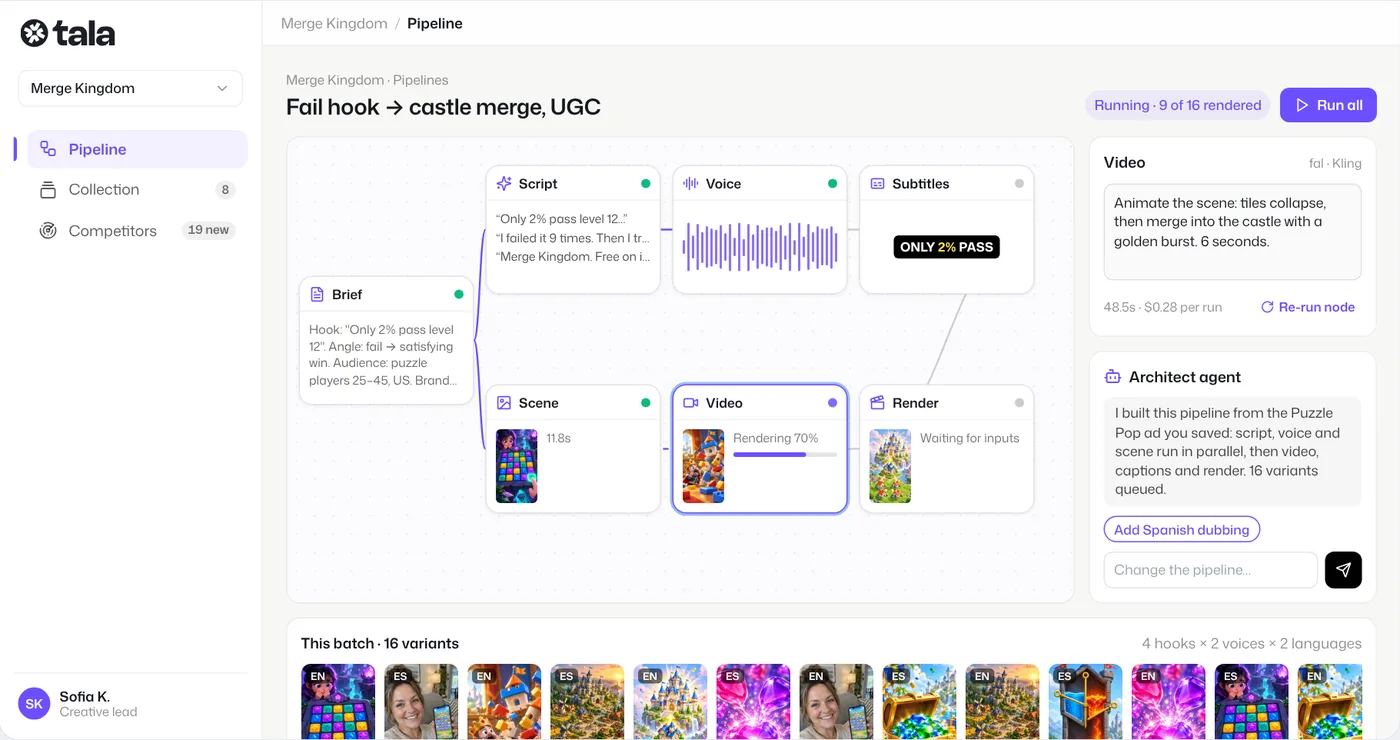
Claude Code is usually how that app gets built. The API is how it runs afterwards. At Tala, Claude agents running on the API built the ad-video pipelines behind 4,000+ videos. On 15 November 2026, Haiku 5.5 cost $0.10 per million input tokens and $0.50 per million output tokens (for prompts up to 100,000 tokens). Sonnet 5.5 cost $2 and $10.
Which one to use: 8 common jobs
| The job | Use | Why |
|---|---|---|
| Answer a tricky customer email | Chat | One-off, and you want to edit the words yourself |
| Ask questions about a 40-page contract | Chat (a Project if it repeats) | Reading and back-and-forth; nothing to run |
| Month-end close from QuickBooks | Cowork with the Small Business plugin | Several steps across your tools, with you approving |
| A weekly report from a folder of exports | Cowork, as a scheduled task | Same steps each week, output is a file you read |
| Clean and de-duplicate a 5,000-row lead list once | Cowork, or Claude Code if it will repeat | A one-off fits Cowork; a monthly job deserves a script |
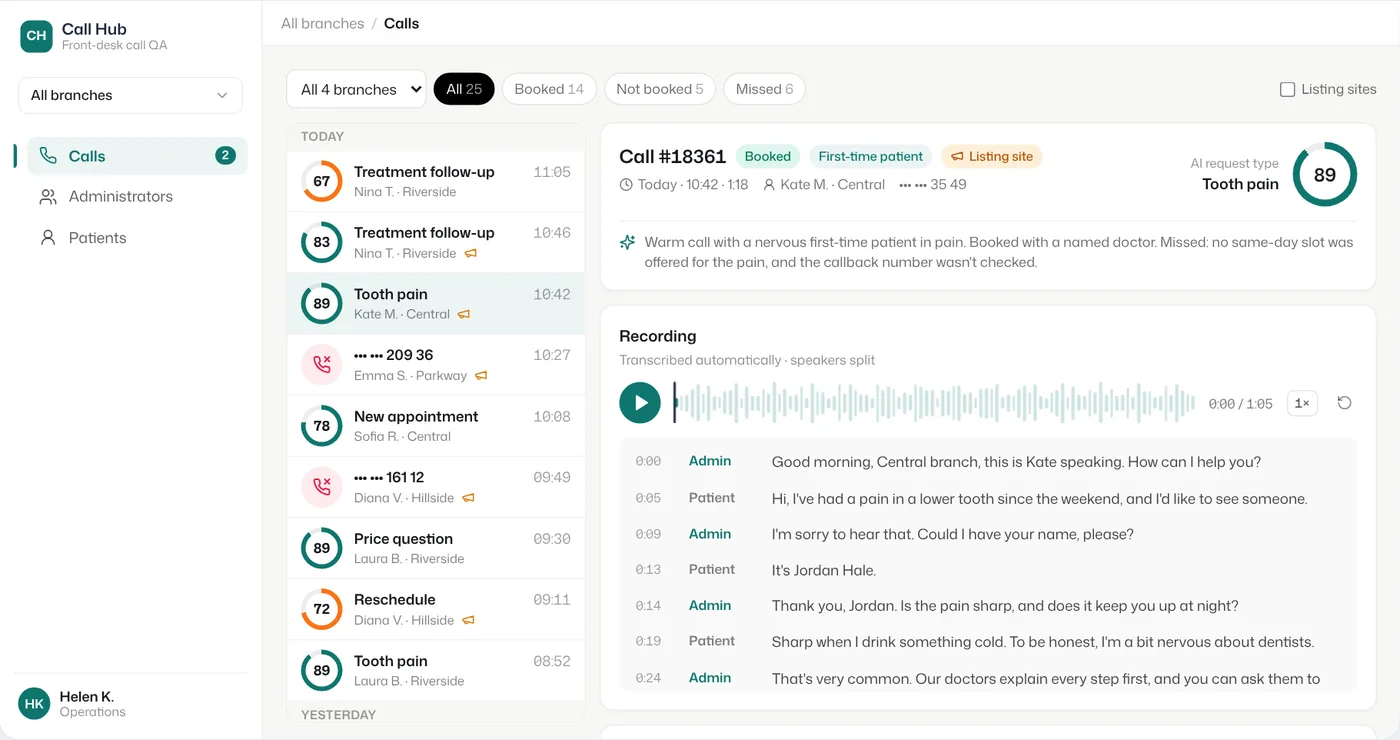
| Score every sales call against a checklist | Claude Code to build it, the API to run it | Same check on every record; our dental network scores 1,200 calls a month |
| Sort every reply from cold email | Claude Code to build it, the API to run it | Runs on every reply with nobody clicking; 90% matched for the broker |
| A CRM or client portal your team logs into | Claude Code | Needs a database, logins and a screen; see build your own CRM |
Swipe the table sideways for all columns. Our numbers come from the linked case pages. The dental pipeline runs on OpenAI models with n8n; the job shape is the same in Claude.
When not to use any of them
- The rule is fixed. "When the invoice is paid, mark the deal won" needs no model. Your tool's own automation or a few lines of code does it the same way every time.
- The volume is tiny. Twenty calls a week can be heard by a manager. A pipeline pays off at hundreds a month.
- Nobody will check the output. Cowork asks before big steps for a reason. If nobody will read what Claude produced, don't hand it the decision.
- The data can't leave your systems. Check your contracts and your industry's rules before you upload client data or connect a client's tools. Anthropic says Team and Enterprise don't train on your content by default; your own compliance check still comes first.
- You need pictures. Claude doesn't generate photos or illustrations (Anthropic's help page). Our kitchen visualizer uses an image model for that.
- A non-developer is about to ship a customer-facing app alone. Logins, data permissions and backups need someone who knows what to check.
What each one costs, checked 15 November 2026
| Plan | Price | Chat | Cowork | Claude Code |
|---|---|---|---|---|
| Free | $0 | Yes, limited | No | No |
| Pro | $17 a month billed yearly, or $20 monthly | Yes | Yes | Yes |
| Max | $100 a month, 5× Pro usage | Yes | Yes | Yes |
| Ultra | $200 a month, 10× Pro usage a week, no 5-hour limit | Yes | Yes | Yes |
| Team, standard seat | $20 per seat a month billed yearly, or $25 monthly (2–150 seats) | Yes | Yes | Yes |
| Team, premium seat | $100 per seat a month billed yearly, or $125 monthly | Yes | Yes | Yes, 5× a standard seat |
| API (Claude Console) | Per token, e.g. Sonnet 5.5 $2 / $10 per million in / out | No | No | Yes, billed per token |
Swipe the table sideways for all columns. Plan prices from claude.com/pricing; Cowork plans from claude.com/product/cowork; token prices from Anthropic's API pricing page. All last checked 15 November 2026, in US dollars. Usage limits depend on the model and the length of your chats.
One plan covers all three. A solo owner starts on Pro. Someone who lives in Claude Code all day moves to Max or Ultra. A small team mixes standard seats with one premium seat for its heaviest user. The full breakdown, including what Anthropic says Claude Code costs per developer, is in Claude Code pricing.
How to pick in ten minutes
- Write down three jobs that ate your time last week.
- For each, ask: do I want an answer, a finished file, or something that runs every time without me?
- Answer → chat. Finished file → Cowork. Runs every time → Claude Code to build it, the API to run it.
- Try the chat and Cowork jobs on Pro this week, on real examples, and count how many come back right.
- For the third kind, collect 20 real examples with the answer a good employee would give. They become the first test set for whatever gets built, by you in Claude Code or by someone like us.
If your marketing is one of those jobs, the skills we load into Claude for it are in Claude skills for marketing.
Questions people ask
- What is the difference between Claude Cowork and Claude Code?
Both let Claude work in many steps on its own. Cowork is built for office work: files, research, reports and the tools you already use, with you approving big steps. Claude Code is built for software: it reads and writes code, runs commands and builds apps that keep running after the session ends.
- Is Cowork included in Claude Pro?
Yes. On 15 November 2026 Anthropic's Cowork page listed it for Pro ($17 a month billed yearly or $20 monthly), Max, Ultra, Team and Enterprise. It is not on the Free plan. Cowork uses your plan's limits faster than chat does.
- What is the difference between Claude and Claude Code?
Claude is the assistant you chat with on the web, desktop and mobile. Claude Code is the same models set up to work on software: it can open a project, edit files, run commands and tests, and use Git. It comes with every paid plan, not with Free.
- Can non-developers use Claude Code?
Yes, for simple internal tools, and Anthropic now offers it in the desktop app, on the web and on mobile, not only in a terminal. It helps to be comfortable reading what changed. Anything with customer data or several users needs someone to check security, logins and backups.
- Do chat, Cowork and Claude Code share the same usage limits?
Yes. Anthropic's docs say a seat's allowance is shared across Claude chat, Cowork and Claude Code, and resets on a five-hour window and a weekly window. Agent work in Cowork and Claude Code uses it faster than chat.
- Can Cowork run tasks on a schedule?
Yes. Anthropic's page says you can schedule recurring work daily, weekly or monthly, and it keeps running after you close your laptop. For a job that must run on every new record as it arrives, a small app calling the API is the sturdier option.
- Is Claude Code free?
No. On 15 November 2026 the Free plan did not include Claude Code. It comes with Pro, Max, Ultra, Team and Enterprise, or you can pay per token through a Claude Console account.
SOURCES
- 1.Claude plans and pricing (claude.com) · checked 15 November 2026
- 2.Claude Cowork product page (claude.com) · checked 15 November 2026
- 3.Cowork: Claude Code for the rest of your work (Anthropic blog) · checked 15 November 2026
- 4.Claude Code product page (claude.com) · checked 15 November 2026
- 5.Manage costs effectively: shared allowance across chat, Cowork and Claude Code (Claude Code docs) · checked 15 November 2026
- 6.API pricing per model (Claude Platform docs) · checked 15 November 2026
- 7.Can Claude produce images? (Claude Help Center) · checked 15 November 2026
- 8.Case: lead engine and revenue-ops app for a UK funding broker · checked 15 November 2026
- 9.Case: Tala, AI ad creative platform · checked 15 November 2026
- 10.Case: Atlas People talent reports · checked 15 November 2026
- 11.Case: front-desk call QA for a dental clinic network · checked 15 November 2026
Drafted with Claude from our project records; checked and edited by Mark.