AI agents for small business: 10 we put into production, what they replace and cost

- Published
- 15 November 2026
- Prices checked
- 15 November 2026
The AI agents that pay off in a small business do one reading job on every record: score each call, sort each reply, write each report, match each CV. We've put 10 into production since 2024. Each took over work done by hand. Where we measured it, AI cost ran from about $0.14 a render to under $3 a report.
10 AI agents at a glance: what each replaced and what it costs
| Agent | What it replaced | Result | Running cost we measured | Build time |
|---|---|---|---|---|
| Call scoring, dental network | Managers listening to a few calls a week | 1,200 calls a month scored on 18 criteria | Not measured | Scoring live Aug 2025 |
| Sales-call compliance, NextEnergy | A Make.com flow with unexplained scores, results in Excel | 5,000+ calls checked on 30+ criteria | Not measured | 70 hours with the app |
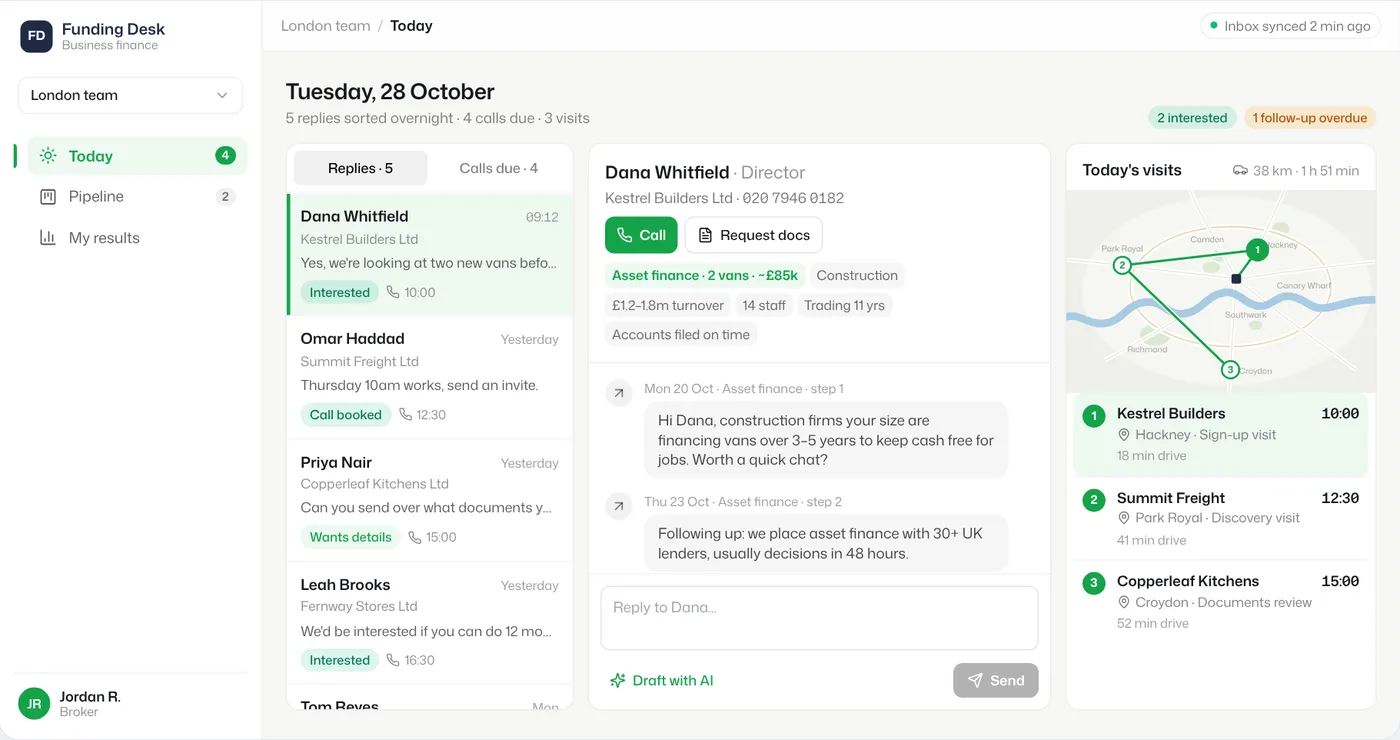
| Lead engine and reply sorting, UK broker | Bought or ad-hoc lead lists with no clear cost per lead | 57,291 → 14,620 qualified leads; 90% of replies matched | ~£0.18 data cost per qualified lead | < 3 weeks |
| Content and tender agents, Baltoro | Copying between GPTs, Canva and Sprout; a 70K-row CSV cleaned by hand | 22 clients on the chatbot; 70K → ~500 tender rows | Not measured | First tool in 30 days |
| Kitchen visualizer | Manual rendering for each design revision | 3,962 renders by the firm's designers | ~$0.138 per render | Live Jan 2026 |
| Talent reports, Atlas People | 3–5 hours writing each report in ChatGPT | 20 minutes per report | < $3 per report | ~4 months to the engine |
| CV matching, Incorra | Reading through 2,000+ candidates for each vacancy | ~500 CVs screened per vacancy; 1,000+ parsed | Not measured | ~8 weeks |
| Ad pipeline agents, Tala | About 3 days per batch of ad creatives | 4,000+ videos, 10M+ views | Not measured | Core live Feb 2026 |
| Job engine (our own) | Reading ~25 job sources by hand | 5,879 postings collected and filed (Oct 2026) | Scraping ≈ $1.30 a day at defaults | – |
| Writing partner (our own) | Drafting LinkedIn posts from a blank page | Top 3 ideas drafted every Monday | Not measured | – |
Swipe the table sideways for all columns. Results and build times from each case page; our own systems from our project records. "Not measured" means no per-item cost was recorded, so we don't guess one. Build time is what the case page states: hours, weeks, or the date it went live.
Eight of these are client systems; two we run for ourselves every day. Three of the client systems are still in our care. The other five were handed over to the client's team, or ended with the engagement.
The pattern is the same in every row. A person used to read something and decide: is this call compliant, is this reply interested, does this CV fit. Now a model reads every one, returns a structured answer with its evidence, and a person checks the edge cases.
What we mean by an AI agent here
Vendors call almost anything an agent now. Here is the plain version.
Most of the ten are one AI step inside ordinary code. Code fetches the call, the reply or the CV. The model reads it and returns an answer in a fixed format. Code saves it, shows it on a dashboard and alerts someone. The model decides one thing; the rules around it stay fixed.
Two are agents in the stricter sense: they pick their own next step and use tools. Tala's architect agent reads a brief, designs a video pipeline and wires the nodes itself. Our writing partner is a Claude agent that edits a post, its hooks and its visual through tools while Mark chats with it.
For a small business, the first kind is where the money is. It's predictable, cheap per item, and easy to check. Start there.
Four of them up close
A kitchen visualizer the design team adopted
AI runs on · Gemini 3 Pro Image for renders, gpt-4.1-mini, n8n and Supabase
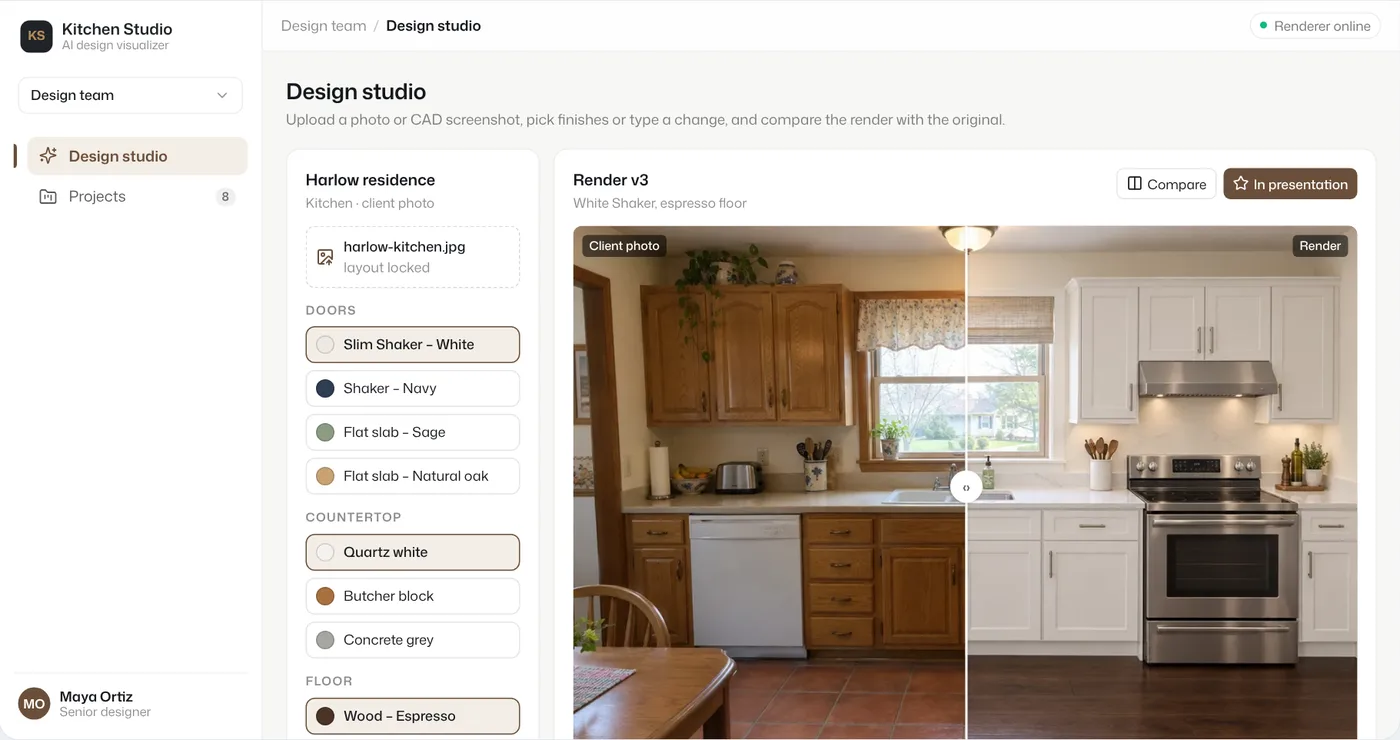
A US kitchen-design firm wanted a tool on its site: a homeowner uploads a photo of their kitchen, picks doors, countertops or floors from the firm's catalog, and sees a realistic render of their own room.
Then the firm's own designers started using it on CAD screenshots and draft renderings for client presentations. Staff renders went from 9 in March to 518 in April 2026 and peaked at 762 in July. By the October audit, the design team had made 3,962 renders. The pipeline logs token use for every run, which is how we know the unit cost.
CV matching inside a recruiter's Pipedrive
AI runs on · OpenAI for parsing and matching; n8n, Bubble and Supabase; inside Pipedrive
Incorra, a tech recruiter in Riga, kept vacancies and 2,000+ candidates in Pipedrive. Matching a new vacancy meant reading candidate after candidate, so good people already in the database got missed.
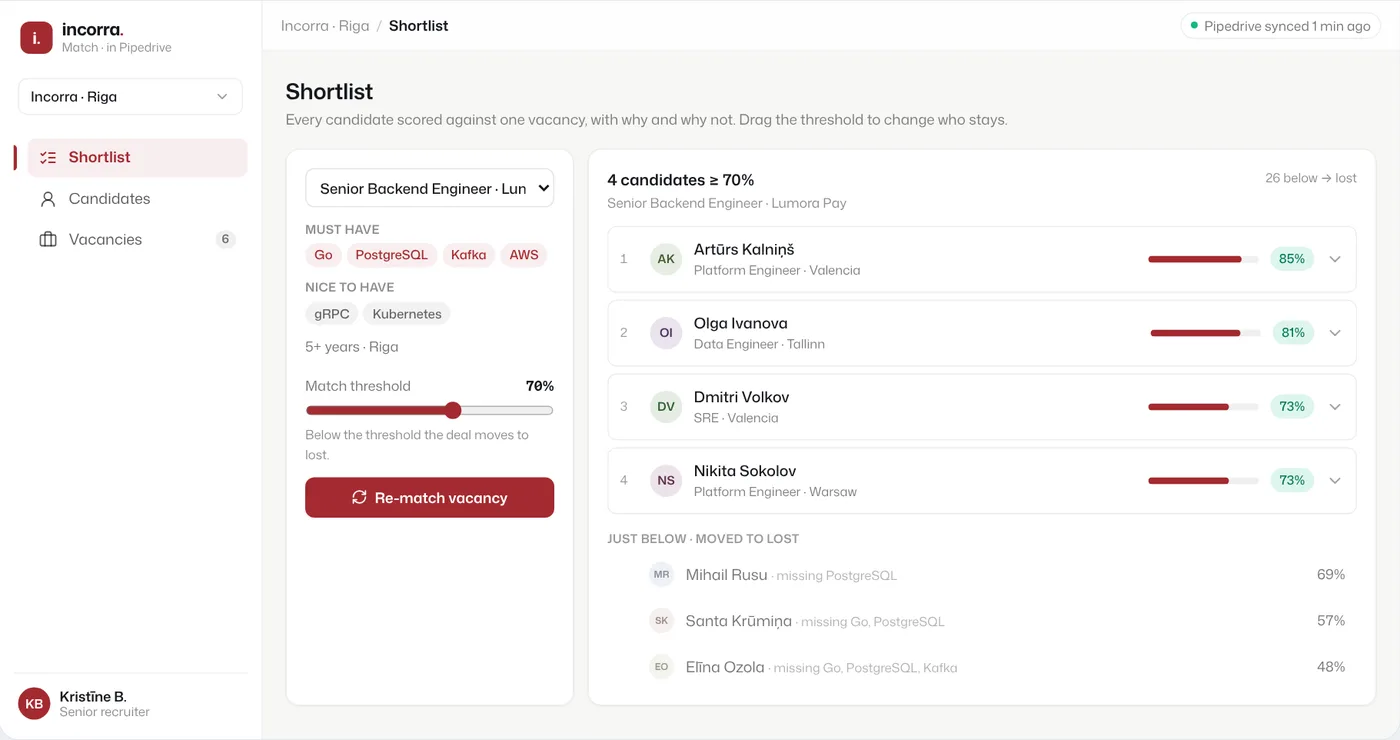
The team didn't want a new applicant system, so the agent lives inside Pipedrive as a panel. Every CV is parsed into a structured profile. Each new vacancy is scored against about 500 candidates, with a match percentage and a short why or why not. New candidates are checked against open roles too. One vacancy was filled straight from people already in the database.
Front-desk call scoring for a four-branch dental network
AI runs on · OpenAI GPT for scoring, speech-to-text AI for transcripts, n8n and Supabase
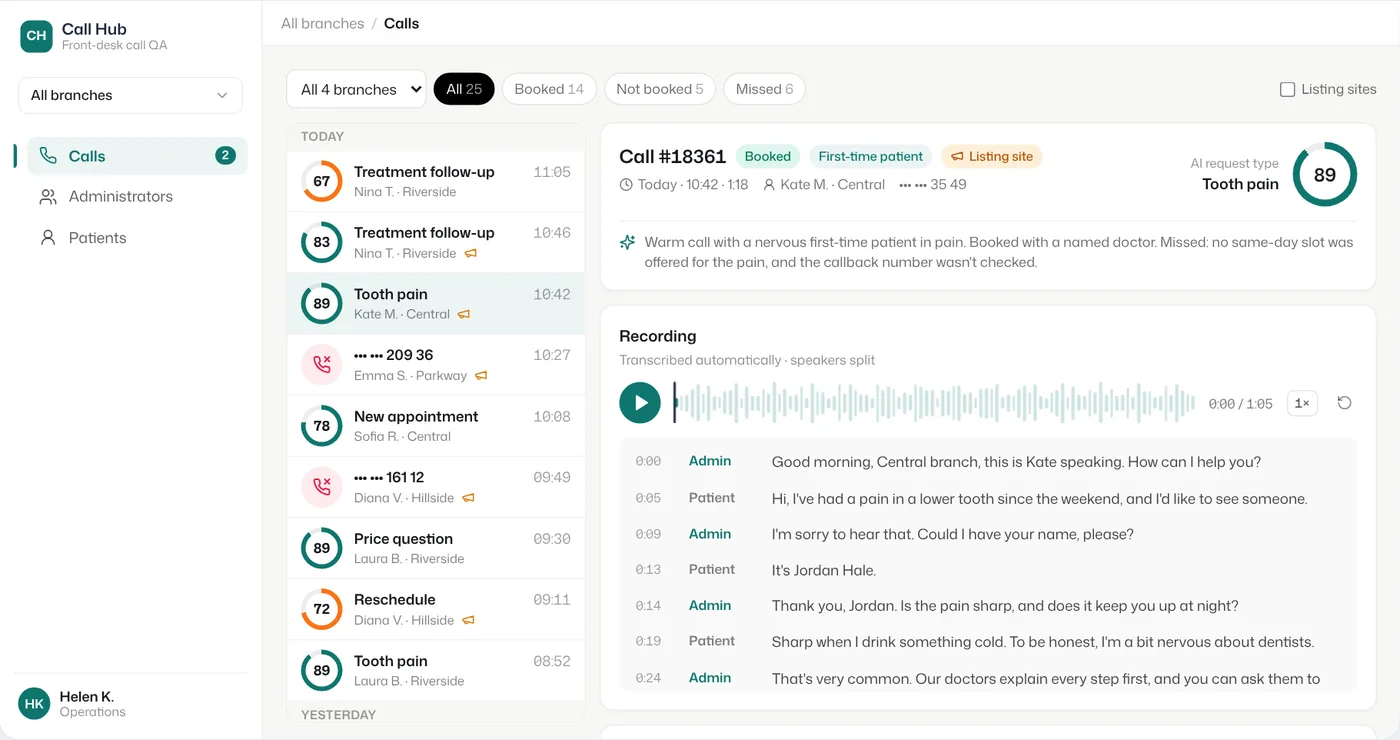
Every call from four branches, missed ones included, is pulled from the telephony system, transcribed and scored on 18 criteria: greeting, the patient's situation, their fears, the treatment offered, the booking. The prompt may only return verbatim quotes as evidence, so a manager can check every mark in seconds.
This is the clearest "what it replaces" in the list. Before, managers could listen to a handful of calls a week. Now every answered call gets the same check, and the Call Hub shows each administrator's weakest criteria.
Two kinds of call were counted wrong at first. Missed calls from first-time patients were misclassified, and calls from doctor-listing sites were mixed in with the rest. Both now get their own handling: first-time missed calls are classified correctly, and listing-site calls carry a badge, so the clinic sees what those sites bring in.
Our own job engine
AI runs on · A small OpenAI model, on a Next.js and Supabase app with daily scheduled jobs
We built this one for ourselves. Every morning it collects remote roles from about 25 sources, follows links through to the real posting, and asks a model a list of narrow questions: is this a real posting, which role type, remote for which regions, open to someone in Georgia, what seniority, what salary. A dashboard shows only what passes.
It runs at 07:00 UTC with nobody touching it. Scraping through Apify cost about $1.30 a day at default settings; that part has been paused since 28 October 2026.
Location calls needed a backstop. Code rules now run after the AI: a 401(k) mention means US-only, and a "not open to Georgia" verdict needs explicit wording in the posting. The model reads; fixed rules settle the cases it gets wrong.
The other six, briefly
- NextEnergy, sales-call compliance. Partner recordings arrive on FTP; each call is transcribed and checked against 30+ yes/no compliance criteria, repeated for consistency. The old flow asked for one score per call, and scores jumped from 60 to 85 for no clear reason. Many narrow questions fixed it.
- UK funding broker, lead engine and reply sorting. Public-register data runs through a waterfall to 14,620 qualified leads, 72% with an email. Replies come back from outreach and an AI step sorts each into one of 8 intents.
- Baltoro, content and tenders. Posts in each client's voice, a weekly government-tender hunter for 6 clients, news-trigger leads, and a marketing chatbot used across 22 clients.
- Atlas People, talent reports. Psychometric tests, CVs and role notes become job-analysis and candidate reports. Each report section has its own prompt and output format; guardrails stop the model inventing talents or mixing languages.
- Tala, ad pipeline agents. A main Claude agent works with architect, editor, animator and playable agents. One ad concept turns into many variants in parallel. Customers reported a batch going from 3 days to one morning.
- Our writing partner. Claude drafts three hooks and a post for each idea in Mark's voice, and a chat agent edits it with him. Mark edits every draft before it is posted.
What an AI agent costs a small business
There are three costs: building it, running it, and checking it.
Running is usually the smallest. Where we measured it: about $0.138 per kitchen render, under $3 per 20-minute talent report, about £0.18 of data per qualified lead. Model prices per token are low and still falling. The table below shows what the models and two ready-made agents charge.
| Option | Price, checked 15 Nov 2026 | Billed by | Fits |
|---|---|---|---|
| Claude Haiku 5.5 (API) | $0.10 in / $0.50 out per million tokens | Tokens | High-volume sorting and short checks |
| Claude Sonnet 5.5 (API) | $2 in / $10 out per million tokens | Tokens | Longer reading: transcripts, contracts, reports |
| Claude Opus 5.5 (API) | $4 in / $20 out per million tokens | Tokens | The hardest reasoning steps |
| Intercom Fin (ready-made) | $0.99 per outcome, 50 outcomes a month minimum | Outcomes | Customer support on your help desk |
| Zapier Agents (ready-made) | Included on Zapier plans: 400 activities a month on Free, 1,500 on Pro | Activities | Light tasks across apps you already connect |
Swipe the table sideways for all columns. From Anthropic's API pricing (Haiku price for prompts up to 100,000 tokens), fin.ai/pricing (plus $19 per help-desk seat if you're on Intercom) and zapier.com/pricing, last checked 15 November 2026.
Building depends on how many systems it touches. From the case pages: 70 hours for NextEnergy's pipeline and app, under 3 weeks for the broker's two apps, about 8 weeks for Incorra's Pipedrive app. Our own offer is a working version in 1 week, from $1,990, running in your accounts.
Checking is the cost people forget. Someone has to read the misses in the first weeks and fix the prompt or the rules. At Atlas People, early tests invented talents and mixed Danish with English until guardrails went in. At NextEnergy, one big score per call had to become 30+ small questions. Budget a few weeks of that before you trust the numbers.
Buy a ready-made agent or build your own?
| Your situation | Our pick | Why |
|---|---|---|
| Answering customer questions on your site or help desk | Buy (Fin, or your help desk's own agent) | A solved problem, priced per outcome |
| A task inside one tool you already use | Try that tool's agent first | No build, no new login |
| The same reading job on every record of your own data | Build | You need your criteria, your evidence and a dashboard |
| The answer has to land in several systems with your rules | Build | Ready-made agents mostly work inside their own app |
| Volume under ~20 items a week | Neither | A person can do it; the 20 become your test set |
Every client system in our table was a build, because each one scored or wrote against the client's own criteria: the clinic's 18-point script, Dutch compliance rules, a recruiter's vacancies. No off-the-shelf agent ships with those. If yours is a common job with a common answer, buy.
When not to use an AI agent
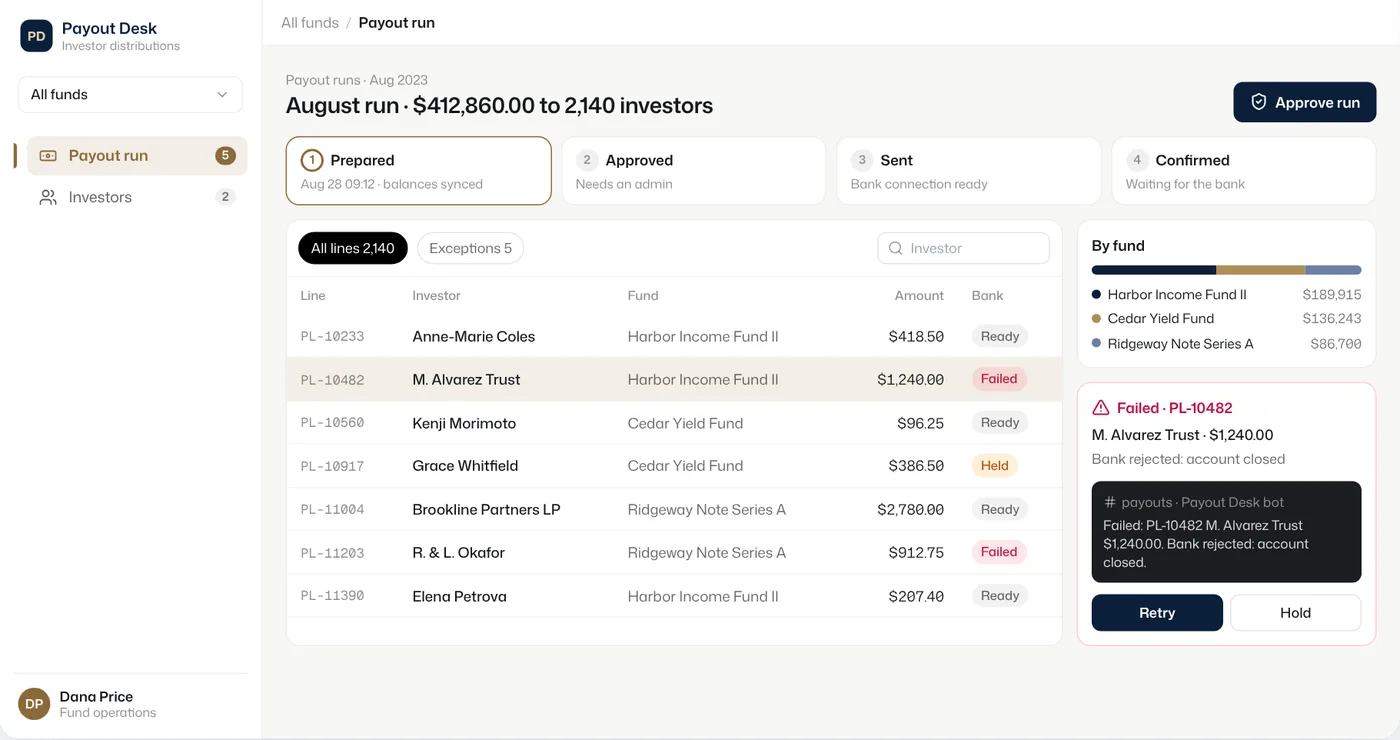
- The rule is fixed. A US private investment firm paid thousands of investors by hand every month, and each run took 3 days. We cut it to about an hour with a step-by-step payout workflow and bank-connected payments. More than $9M went out in a year. There is no AI in it, and there shouldn't be: a payout is arithmetic plus approvals.
- The volume is tiny. The dental build handles 1,200 calls a month. At 20 calls a week, a manager can listen.
- Nobody will check the output. Every agent above shows its evidence: a quote, a reason, a matched contact. If nobody looks, don't hand the decision over.
- The data can't leave your systems. Check client contracts and your industry's rules before any record goes to a model provider.
- You want it to talk to customers unsupervised on day one. Start with a job where a person reviews the output, like scoring or drafting. Move to customer-facing work once you trust it.
How to start with one agent
- Pick one job a person does on every record: every call, every reply, every CV, every report.
- Write down the criteria a good employee uses. Split them into yes/no questions; one big score drifts.
- Collect 20 real examples with the right answer for each.
- Run them through a model in a chat window. Count the hits and read the misses.
- If it holds up, build it as one AI step inside code, with the evidence saved next to each answer and a screen where someone checks the edge cases.
- Measure the cost per item from the first week. You'll want that number later.
Which model? We pick per job. Of the ten above, the reading and scoring mostly runs on OpenAI models, the renders on Gemini, Tala's agents and our writing partner on Claude. More on Claude for this work in Claude for small business, and on when a workflow tool is enough in n8n vs Claude Code.
Questions people ask
- What is an AI agent for a small business?
Software that reads something, decides, and acts without a person doing each step. In practice the useful ones do one job on every record: score a call, sort a reply, match a CV, draft a report. Code around the model fetches the data, saves the answer and shows it to someone.
- How much does an AI agent cost for a small business?
Running costs are often cents to a few dollars per item: we measured about $0.138 per image render and under $3 per written report. Ready-made support agents charge per outcome, for example Fin at $0.99. A custom build costs more up front; ours starts at $1,990 for a working version in a week.
- What tasks can AI agents do for a small business?
From our builds: score sales and support calls, check calls for compliance, sort email replies by intent, find and qualify leads, write reports from tests and CVs, match CVs to vacancies, render design options from a photo, and build ad video variants. Each one replaced a person doing it by hand.
- What's the difference between an AI agent and an automation like Zapier?
An automation follows fixed rules: when X happens, do Y. An agent adds a step that reads and judges, such as whether a reply is interested or a call broke a rule. Most good systems mix both. The rules handle what is fixed, and the model handles what needs reading.
- Do I need a developer to build an AI agent?
Not to test one. You can check the idea on 20 examples in a chat window. To run it on every record, with logins, a database and alerts, you need someone to build and maintain it, whether that's a developer, a builder like us, or a no-code tool for simple cases.
- Are AI agents worth it for a small business?
When the job repeats hundreds of times a month and has a clear right answer, usually yes. Our examples replaced work like 3–5 hours per report or reading 2,000+ candidates per vacancy. For a job that happens a few times a week, a person is cheaper.
SOURCES
- 1.Claude API pricing (platform.claude.com) · checked 15 November 2026
- 2.Fin AI agent pricing (fin.ai) · checked 15 November 2026
- 3.Zapier plans and Agents activities (zapier.com) · checked 15 November 2026
- 4.Case: front-desk call QA for a dental clinic network · checked 15 November 2026
- 5.Case: NextEnergy call compliance scoring · checked 15 November 2026
- 6.Case: lead engine and revenue-ops app for a UK funding broker · checked 15 November 2026
- 7.Case: Baltoro, AI platform for a Chicago agency · checked 15 November 2026
- 8.Case: AI kitchen visualizer for a US design firm · checked 15 November 2026
- 9.Case: Atlas People talent reports · checked 15 November 2026
- 10.Case: Incorra AI resume matching in Pipedrive · checked 15 November 2026
- 11.Case: Tala, AI ad creative platform · checked 15 November 2026
- 12.Case: investor payout portal for a US private investment firm · checked 15 November 2026
Drafted with Claude from our project records; checked and edited by Mark.