n8n vs Claude Code: when you don't need a workflow tool anymore

- Published
- 15 November 2026
- Prices checked
- 15 November 2026
n8n runs workflows: it waits for a trigger, runs the steps and keeps a log. Claude Code writes software: it can build a small app that does the same job with its own database and screens. Keep n8n for app-to-app flows your team edits. Write code when the workflow has its own data, rules and users.
n8n vs Claude Code at a glance
| n8n | A small app written with Claude Code | |
|---|---|---|
| What it is | A workflow platform: triggers, steps (nodes), run history | Code that Claude Code writes for you: a web app, a database and scheduled jobs |
| Price, checked 15 Nov 2026 | Cloud Starter €20 a month billed yearly (2,500 executions). Community Edition free to self-host | Claude Pro $17–20 a month to build and change it, plus hosting: $0 on free tiers, about $45 a month on Supabase Pro and Vercel Pro |
| Who changes it later | Someone who knows n8n nodes | Anyone who can ask Claude Code for the change and check it |
| Runs on a schedule | Built in | You add it: a cron job in Vercel or Supabase |
| Run history and retries | Built in, per node | You build it: a runs table, a retry rule, an alert |
| Its own data and screens | No. It moves data between other apps | Yes: a Postgres database and pages for each role |
| From our builds | Dental call QA: 1,200 calls a month, live about 2 years | UK funding broker: 57,291 companies into 14,620 qualified leads |
Swipe the table sideways for all columns. Prices from n8n.io/pricing, claude.com/pricing, supabase.com/pricing and vercel.com/pricing, last checked 15 November 2026. n8n shows euro prices billed yearly.
We have built 300+ automations for 20+ companies since 2020, many of them in n8n, Make and Zapier. New systems we now write as small apps with Claude Code. The reason is speed: a change that took an hour of clicking through nodes is now a sentence and a review. n8n still wins in a few places, and this post is honest about where.
What n8n and Claude Code actually are
n8n is a place where workflows live and run. A workflow waits for a trigger: a webhook, a schedule, a new file. Then it runs its nodes in order and logs every run. n8n's own page puts it this way: "n8n logs every execution, so you can re-run it from the exact point it failed." It hosts the workflow, schedules it and retries failed steps for you.
Claude Code is Anthropic's coding agent. You describe the job, it reads your code and writes more. It is included from the Claude Pro plan. When the task is done, it stops. n8n's comparison page says it plainly: "Claude Code has no persistent runtime by default."
So the fair comparison is n8n against a small app that Claude Code writes for you: a Next.js app on Vercel, a Supabase database, a few scheduled jobs and a log table. That app does what the workflow did. It also holds its own data and gives your team screens to work in.
The two also work together. Claude Code can build and deploy n8n workflows through n8n's MCP server, so a team that wants to stay on n8n can still let Claude do the clicking. If your team edits workflows every week and likes the canvas, that is a fair middle path.
What each costs per month in 2026
| Item | Price | What you get |
|---|---|---|
| n8n Community Edition | Free to self-host | The standard edition from GitHub. You pay for the server and you keep it updated |
| n8n Cloud Starter | €20 a month billed yearly | 2,500 executions a month, 5 at once, unlimited users and workflows |
| n8n Cloud Pro | €50 a month billed yearly | 10,000 executions a month, up to 50 at once |
| n8n Business | €667 a month billed yearly | 40,000 executions a month, self-hosted |
| Claude Pro (includes Claude Code) | $17 a month billed yearly, or $20 monthly | Enough to build and change a small app. Heavy daily use: Max at $100 |
| Supabase | Free $0, Pro from $25 a month | Postgres database, logins, file storage. Free projects pause after a week idle; Pro has daily backups |
| Vercel | Hobby $0, Pro $20 per developer seat a month | Hosting for the app and its cron jobs. Viewer seats are free |
Swipe the table sideways for all columns. Last checked 15 November 2026 on n8n.io/pricing, claude.com/pricing, supabase.com/pricing and Vercel's Hobby plan docs. n8n counts one run of a whole workflow as one execution, however many steps it has.
The volume decides the n8n bill. A workflow that checks for new data every 5 minutes runs 288 times a day, about 8,640 times in a 30-day month. That is past Starter's 2,500 and inside Pro's 10,000. Add a second workflow on the same schedule and you are near the limit again.
A small app costs the same whether a job runs 100 times a month or 100,000 times, until the database or the functions get big. For a business app we use paid plans: Supabase Pro at $25 and one Vercel Pro seat at $20, so about $45 a month for hosting. The Claude plan is what you pay to change it.
The bigger cost is missing from every price page: the hours someone spends finding which node broke, and the hours to add a feature. That is where code got cheaper in 2026, because Claude Code writes and changes it.
Where n8n still wins: two systems we run on it
Both of these are AI pipelines: a recording comes in, gets transcribed, a model scores it, the result lands in Supabase and a dashboard shows it. n8n is a good fit for that shape. Each call is one run, and the run log shows exactly which step failed for which call.
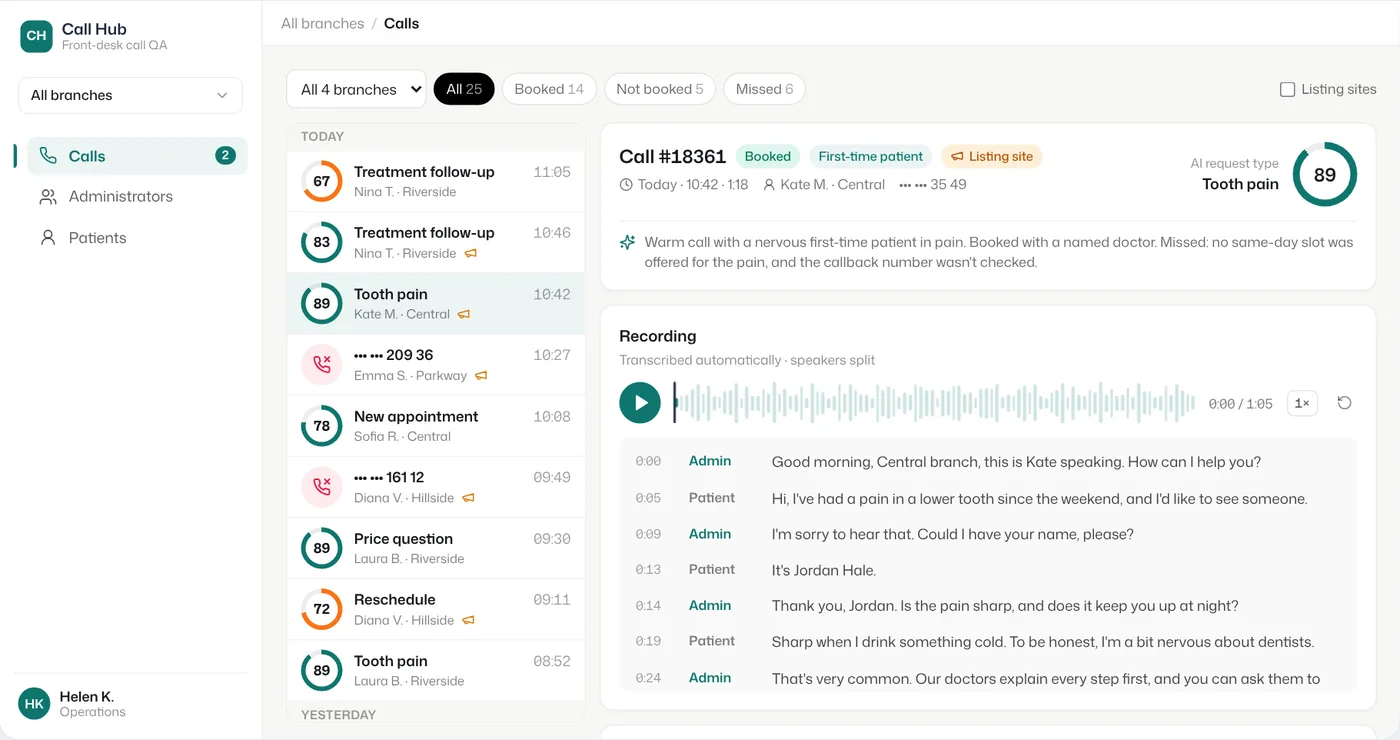
Front-desk call scoring for a four-branch dental network
AI runs on · n8n, speech-to-text AI, OpenAI GPT, Supabase, a React dashboard built in Lovable
n8n pulls every call from the telephony API, missed ones included. Answered calls are transcribed and scored by GPT on 18 criteria, each backed by a verbatim quote from the call. Scores land in Supabase, and a Call Hub dashboard shows calls, administrators and each patient's history, with pages loading in 20–40 ms.
It has been in daily use for about 2 years and is still being improved. We keep it on n8n because the pipeline is stable and the run history helps when a manager questions a score.
The telephony API only answers requests from inside its own region, so n8n couldn't reach it. A small relay server fixed that. Calls from doctor-listing sites were mixed in with the rest; they now get a badge, so the clinic sees what those sites bring in.
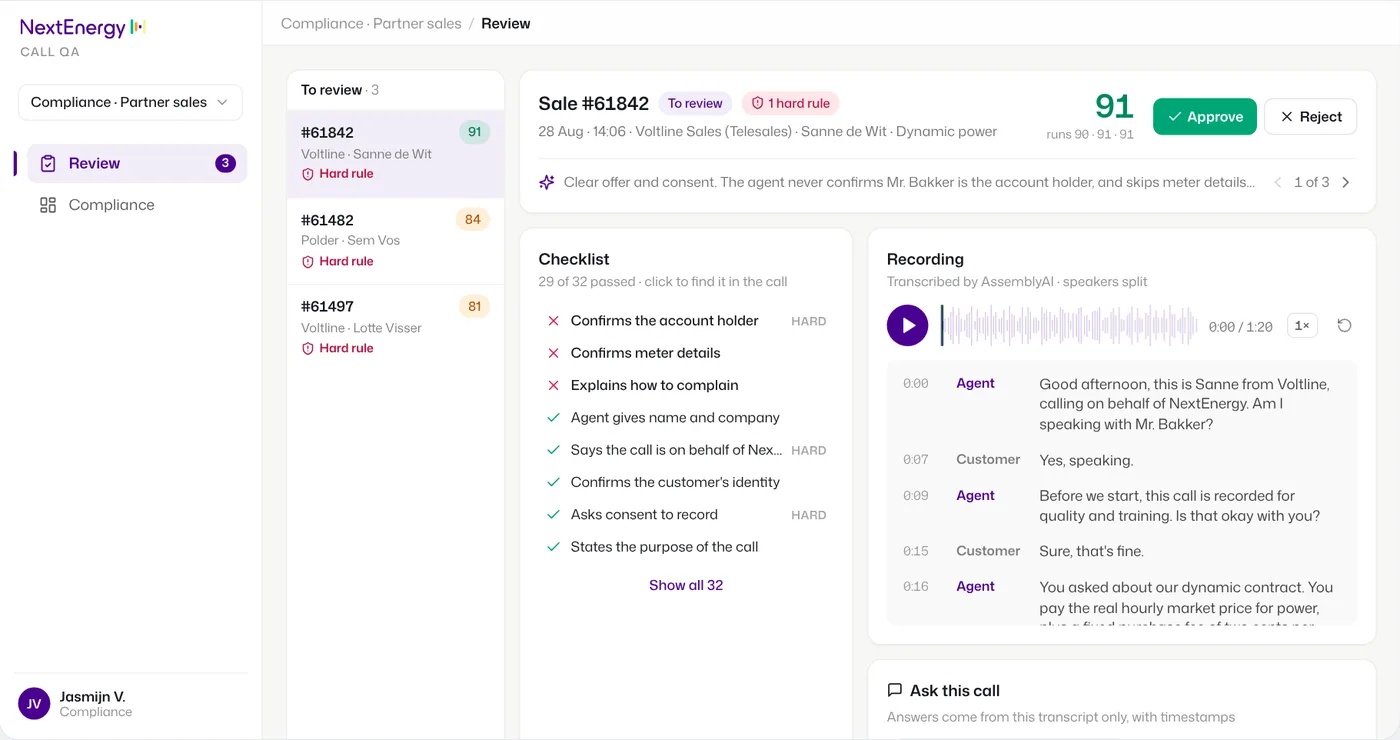
Compliance checks on every sales call for NextEnergy
AI runs on · n8n, AssemblyAI, OpenAI, Supabase, a web app built in Lovable
NextEnergy, a Utrecht energy supplier, sells partly through outside partners who upload call recordings to FTP folders. n8n picks up new files per partner in batches, matches each to its sale through the Salesdock API, sends it to AssemblyAI and asks OpenAI 30+ yes/no questions. A dashboard compares partners and agents over time. The pipeline and the web app took 70 hours to build.
This replaced a Make.com flow that asked the model for one score per call. Scores could "jump from 60 to 85 without any clear reason". Moving to n8n didn't fix that on its own. We split the score into 30+ narrow questions and repeat the checks for consistency. The same lesson holds in code.
What these two have in common: one item in, one result out, a fixed order of steps, and no screens inside n8n itself. The dashboards are separate apps on Supabase. n8n is the conveyor belt between them.
Where we write code instead: the broker app
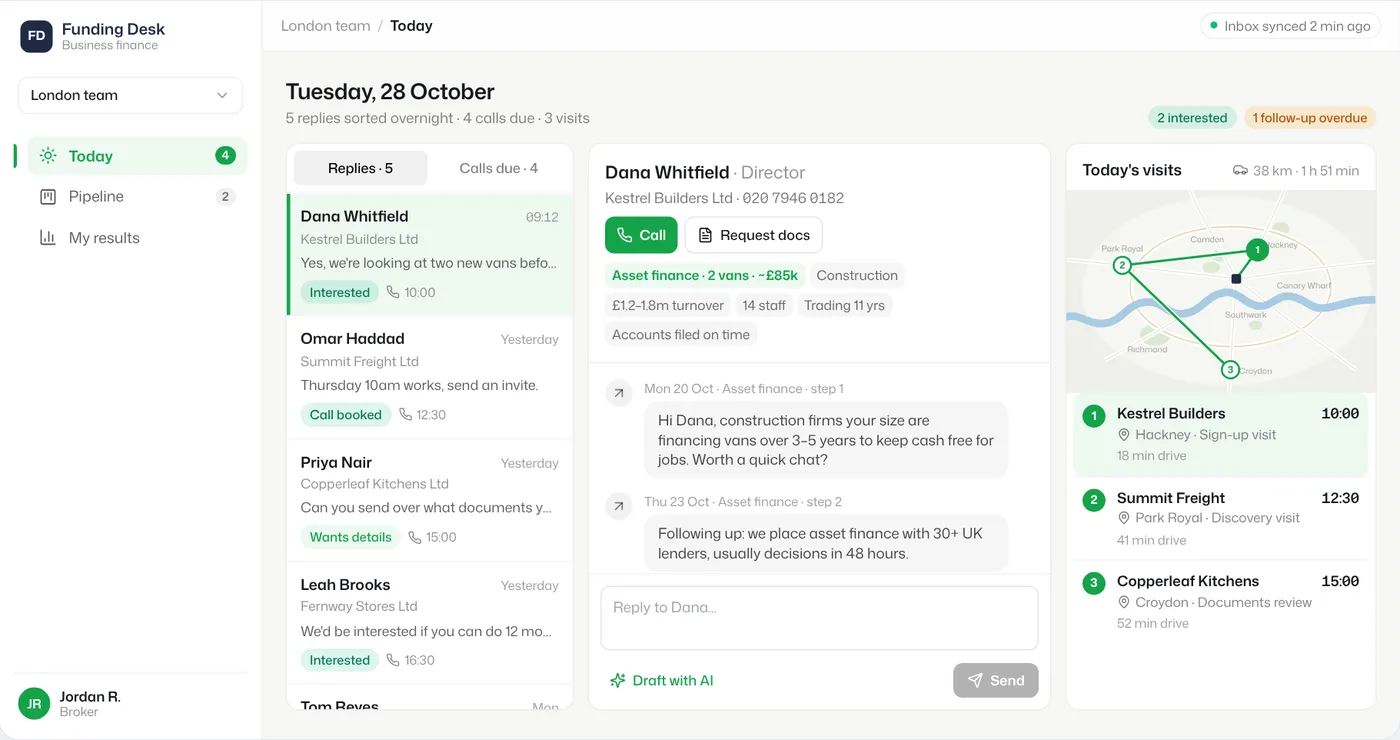
Lead engine and revenue-ops app for a UK funding broker
AI runs on · Built with Claude Code. Next.js and Supabase on the client's own Vercel account; AI sorts the replies
The broker needed leads, outreach and follow-ups in one place. We wrote one app: a waterfall that filters and enriches public-register data at about £0.18 of data cost per qualified lead, a sync with the outreach tool, and an AI step that sorts each reply into one of 8 intents and matches it to the contact. 90% of replies are matched with nobody touching them.
As workflows, this would be many separate flows reading and writing the same leads, each with its own copy of the rules. As code, it is one app with one place to change a rule. Both apps ran on the client's own accounts less than 3 weeks after the broker side was onboarded.
The tool the broker trusted was the one that had failed. On their Monday.com board, 32 follow-up rules had stopped firing in July, 498 follow-ups were more than 30 days overdue, and the next follow-up date had been typed by hand 187 times. We audited all 32 and rebuilt the 12 that mattered.
Our own systems run the same way. Our outreach app drafts follow-ups on a 5-minute schedule and posts each one to Telegram. Our content hub schedules posts with Supabase pg_cron every 10 minutes. Both are Next.js and Supabase, written with Claude Code, with no workflow tool in between.
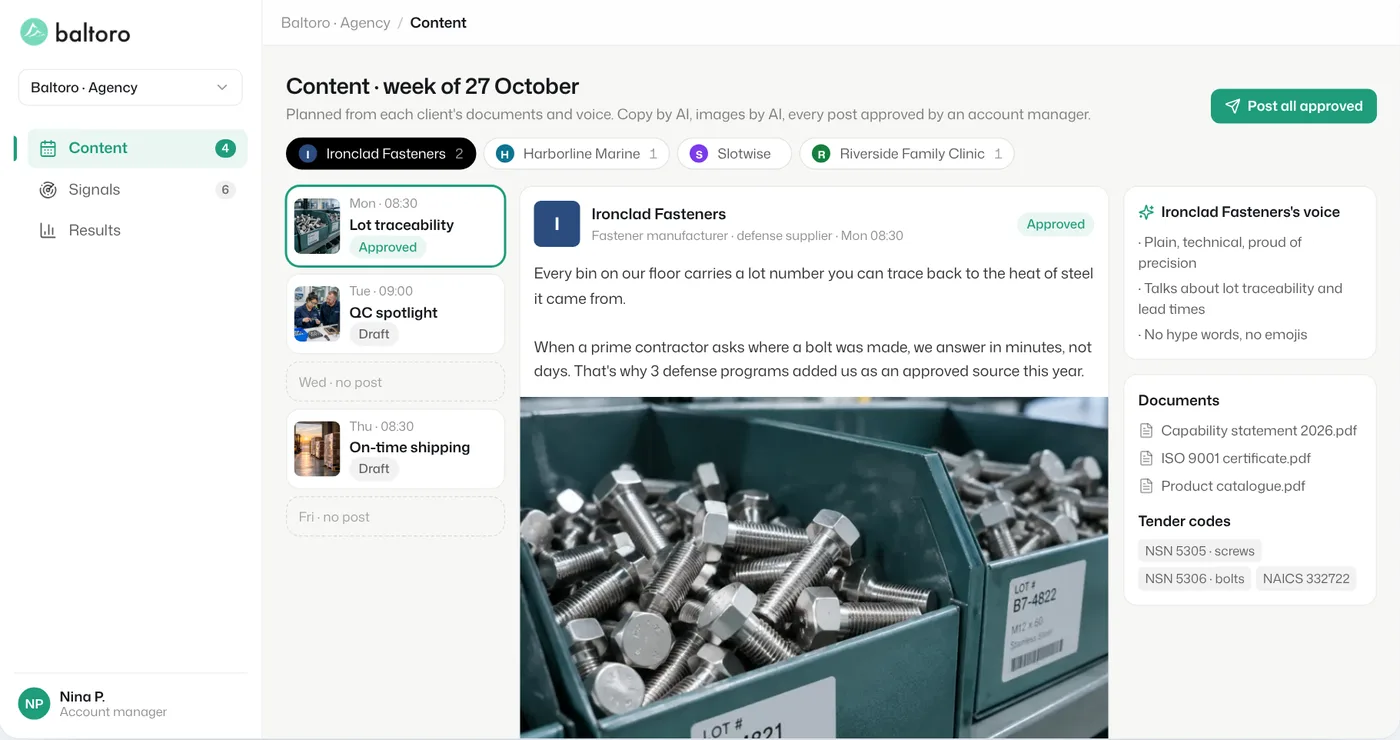
The file-size limit pushed us too. At Baltoro, a Chicago agency, a 70,000-row tender CSV crashed n8n and hung Make, so someone cleaned it by hand. A small pre-filter tool in code now cuts it to about 500 relevant tenders each time.
7 signs you've outgrown the workflow tool
- The workflow needs its own data. You keep a Google Sheet or an Airtable base just so n8n has somewhere to store state.
- Several workflows share the same records. A rule change means editing three flows and hoping you found them all.
- People need a screen. Staff want to review, approve or correct what the workflow did. That screen is an app, so the workflow might as well live in it.
- The logic is a wall of IF nodes. Branches inside branches are easier to read, test and change as code.
- The files are big. Tens of thousands of rows, large archives, long transcripts in one go.
- The execution bill grows with every schedule. Polling every few minutes, per item, on several flows adds up.
- Nobody wants to touch it. The person who built it left, and the canvas is the only documentation.
One or two of these is normal. Four or more and the workflow is really a small product. It will be cheaper to run and change as one.
How to move a workflow from n8n to code
This is the path we use. It keeps n8n running until the new version has proven itself on real data.
- Export the workflow. n8n saves any workflow as a JSON file. Put it in a new repository with a short note on what it is for and who uses the result.
- Let Claude Code read it. Ask for a plain-language list of triggers, steps, credentials and outputs. Check it against what you know. This list becomes the spec.
- Move the data first. If the workflow writes to a sheet or a base, create the tables in Supabase and import the history.
- Write each trigger as a function. A webhook becomes an API route; a schedule becomes a cron job (Vercel cron for daily jobs, Supabase pg_cron for every few minutes).
- Add what n8n gave you for free. A runs table with start, end, status and error. A retry rule for calls to outside APIs. An alert to Slack, email or Telegram when a run fails.
- Run both side by side. Feed the same inputs to both for a week or two and compare outputs.
- Switch, then switch n8n off. Deactivate the old workflow, keep the export, and note the date.
A single workflow is a small job. A tangle of flows sharing data is a small app build; ours start from $1,990 with a working version in a week, in your accounts.
When not to switch
- The workflow works and nobody touches it. A stable flow that costs €20 a month is fine. Don't migrate it because a newer tool exists. Our dental pipeline stays on n8n for that reason.
- Your team edits the workflow itself. If an ops person changes steps every week and is happy in the canvas, n8n gives them that without a developer. Code gives that power to whoever reviews Claude's changes.
- It only moves data between two SaaS apps. "New form entry → CRM contact → Slack message" needs no database and no screen. A workflow tool is the shortest path.
- You need the run log for an audit, and nobody will build one. n8n's per-node history comes free. In code it's a table you have to design and keep.
- Nobody on your side can check a code change. Claude Code writes good code, but someone has to read the diff, test it and own the accounts. If that is nobody, hire a builder or stay on the tool.
Questions people ask
- Can Claude Code replace n8n?
It can replace the building, not the running. Claude Code writes the code for the job; something still has to host it, run it on a schedule, retry failures and alert you. With a host such as Vercel, a database such as Supabase and a cron job, a small app does what the workflow did. n8n's own page says Claude Code can't replace it "on its own".
- Is n8n still worth learning in 2026?
Yes, if you run app-to-app workflows that a non-developer edits, or AI pipelines with a fixed order of steps. Two of our client systems still run on n8n. For anything with its own data, screens and many rules, we now write the app with Claude Code instead.
- Can Claude Code build n8n workflows?
Yes. n8n's comparison page says Claude Code can deploy an n8n workflow through n8n's MCP server, and community MCP servers do the same. That suits a team that wants to keep n8n but stop clicking through nodes by hand.
- Is n8n free?
The Community Edition is free to self-host; you pay for the server and the upkeep. n8n Cloud starts at €20 a month billed yearly for 2,500 executions (checked 15 November 2026). Pro is €50 for 10,000 executions.
- How much does Claude Code cost?
It is included in Claude Pro at $17 a month billed yearly or $20 monthly (checked 15 November 2026). People who use it all day move to Max at $100 or Ultra at $200. The app it builds needs hosting on top: $0 on free tiers, about $45 a month on Supabase Pro plus one Vercel Pro seat.
- Do I need to be a developer to use Claude Code instead of n8n?
Not to build a first version. To run it for a business, someone has to review changes, set up logins and backups, and own the accounts. That is a smaller job than writing code, but it is a job.
SOURCES
- 1.n8n pricing (n8n.io) · checked 15 November 2026
- 2.n8n vs. Claude Code (n8n.io) · checked 15 November 2026
- 3.Claude plans and pricing (claude.com) · checked 15 November 2026
- 4.Supabase pricing (supabase.com) · checked 15 November 2026
- 5.Vercel pricing (vercel.com) · checked 15 November 2026
- 6.Vercel Hobby plan (Vercel docs) · checked 15 November 2026
- 7.Case: front-desk call QA for a dental clinic network · checked 15 November 2026
- 8.Case: NextEnergy call compliance scoring · checked 15 November 2026
- 9.Case: lead engine and revenue-ops app for a UK funding broker · checked 15 November 2026
- 10.Case: Baltoro, AI platform for a Chicago agency · checked 15 November 2026
Drafted with Claude from our project records; checked and edited by Mark.