AI agent cost in 2026: what one agent costs to build and to run

- Published
- 25 November 2026
An AI agent for one small-business job costs about $45 a month to host plus a few cents per run in model fees. The build costs more: weeks of your time with Claude Code, or a builder's quote. Ready-made agents charge per result, like $0.99 per Intercom Fin outcome. Count the runs and measure one first.
AI agent cost by route
| Route | To build | To run, per month | Fits when |
|---|---|---|---|
| Ready-made agent in a tool you pay for (Intercom Fin, HubSpot customer agent) | No build; your set-up time | Fin $0.99 per outcome, $49 minimum. HubSpot $0.50 per resolved conversation, Professional or Enterprise only | Support questions answered from your help articles |
| Zapier Agents | No build; your set-up time | Free: 400 activities. Pro: from $33.33 billed yearly, 1,500 activities | Light jobs across apps already connected to Zapier |
| Your own agent, built with Claude Code | Claude Pro $20 a month while you build, plus about 60 hours of your time (step 5) | About $45 hosting plus a few cents per run | The job follows your own rules and must run on every request |
| Your own agent, built by a hired builder | A quote. One agency's cost guide says $5,000 to $50,000 for freelance work | The same $45 plus per-run fees, and whatever upkeep costs you | You want it built and looked after for you |
| Your own agent, built by us (lowcoding.dev) in your accounts | From $1,990, a working version in 1 week | The same $45 plus per-run fees, paid to the providers; maintenance from $1,000 a month if you want it. Year one for the example in step 4, build plus software and model fees: from $2,653, or $14,653 with 12 months of maintenance | You want a fixed price agreed before work starts |
The hosting figure is Supabase Pro ($25), the database, and Vercel Pro ($20), which runs the code. The freelance range comes from the AI Agents Plus cost guide, which puts agencies at $25,000 to $250,000 and more. In this guide, freelancers and agencies are both a hired builder.
Those ranges cover everything from a support bot to a system across many tools. Your agent does one job, and you can price it from your own data before anyone sends a quote. The rest of this guide does that for one company: count the runs, measure one run on real samples, add what multiplies it, add the fixed costs and the people time, then price the build and the upkeep.
The example: Saltmarsh Movers and its quote requests
Saltmarsh Movers has 22 people: the owner, two move coordinators and four crews. Quote requests arrive through the website form and by email, about 300 a month and 450 in the summer peak. Each one lists the addresses, the date and the contents of the home, often as a long list typed by the customer.
A coordinator reads each request, works out how much stuff there is, picks the crew size and truck, checks the calendar and emails a quote. That takes about 12 minutes a request, so roughly 60 hours a month go into quotes. The owner wants an agent to do the reading and draft the quote, with a coordinator checking each one before it goes out.
The agent decides two things per request: the volume of the move and the crew it needs. The price itself comes from Saltmarsh's rate card in ordinary code, so the model never invents a number.
Step 1: count how often the agent will run
Every running cost in this guide is a price per run times the number of runs, so start with the count. Claude can do the counting from your inbox or an export.
Set-up, in the Claude app: Customize → Connectors → Gmail → Connect, sign in on Google's page, then under Tool permissions set the search and read tools to Always allow and every tool that drafts or sends to Blocked (how connector permissions work). No Gmail? Export the last 90 days of form submissions from your website or CRM as a spreadsheet and attach it to the chat instead.
I'm pricing an AI agent for one job in my business: [the job, e.g. reading each new quote request and drafting the quote]. Help me count how often it would run. 1. In the connected Gmail, or in the file I attached, find every item of this job from the last 90 days: [where they arrive, e.g. website form notifications to sales@]. Don't copy names, emails or phone numbers into your answer. 2. Give me a table of items per week for the last 13 weeks, the busiest week, the share with attachments (photos, PDFs), and how many are short (under 100 words), medium and long (over 400 words). 3. Sort them into up to 8 kinds with a count for each, and mark the kinds a person should always handle. 4. Ask me, one question at a time, about what you can't see: other channels such as phone or WhatsApp, seasonal peaks, and how long one item takes a person today. Suggest the likely answer each time so I can confirm or correct it. 5. When I say "done", end with three numbers: runs per month now, runs in the peak month, and hours a month the job takes today.
Quote requests, last 13 weeks (September to November): 61 to 84 a week, busiest week 84. With attachments: 22% (mostly photos of rooms). Length: short 31%, medium 52%, long 17% (long ones are full inventory lists). Kinds: local move 58%, long-distance 21%, packing only 7%, storage 5%, office move 4%, piano or safe 3%, not a fit 2%. Always a person: office moves, piano or safe, anything with a claim or complaint. Runs per month now: about 300 Runs in the peak month: about 450 (your answer: June to August) Hours a month today: about 60 (12 minutes a request, your answer)
Keep the peak number. Saltmarsh's 450 summer requests make the model bill 1.5 times an average month, and the spend limit in step 6 is set from it.
Step 2: measure one run on your own samples
Steps 2 and 6 are for whoever builds the agent, in Claude Code. If that isn't you, read the results and go on to step 3, and ask any hired builder to run this test on your samples before they quote. We use Claude here; other providers also bill per token, so you can add their models and prices to the same test.
A model is billed per token, the chunks of text it reads (input) and writes (output). One run's cost is its input tokens times the input price plus its output tokens times the output price. Saltmarsh's requests averaged 4,000 tokens in, and the largest took 6,950, because a typed inventory list can be longer than the instructions. Measure them. Every Claude API response carries a usage field with input_tokens and output_tokens, and the token counting endpoint is free if you only want counts.
You need a Claude Console account for this, separate from a Claude chat plan:
- Cap the spend first. In the Claude Console (platform.claude.com) open Spend limits and set a limit of $10 for the test.
- Make a key. API keys → Create key, named "cost test". The full key is shown only once.
- Put it where Claude Code's file tools can't open it. In your project folder, ask Claude Code to create a file called .env.local with the line ANTHROPIC_API_KEY= and nothing after it, to check that .env* is listed in .gitignore, and to add the deny rule "permissions": { "deny": ["Read(./.env)", "Read(./.env.*)"] } to .claude/settings.json (Claude Code settings). A .env file is a plain text file with one NAME=value line per key; your code reads it when it starts. Open it in your own editor and paste the key after the = sign. The deny rule stops Claude's file tools opening the file, but it isn't a hard wall: grep -r or a script Claude runs could still read it, so use a test key with a small limit here and keep live keys in your host's secret settings.
- Don't export ANTHROPIC_API_KEY in the terminal you start Claude Code from: Claude Code would then bill your work to the API instead of your plan.
Then put 20 real examples of the job in a samples folder, with names and contact details replaced, and a one-page description of the job in docs/job.md (what the agent reads, decides and returns, and the runs per month from step 1). Our guide to building your first agent has a prompt that writes that page with you.
Build a cost test for an AI agent before we build the agent itself. Show me the plan before you write code. - samples/ holds 20 real examples of the job, with personal details replaced. docs/job.md says what the agent reads, decides and returns, and how many runs a month to expect (now and in the peak month). - Write prompts/draft.md from docs/job.md: the agent's instructions, under 40 lines, asking for the answer as JSON. - Write scripts/cost-test.ts. For each sample, call the Claude API with prompts/draft.md as the system prompt, once on each of the current Haiku, Sonnet and Opus models (take the model IDs from platform.claude.com/docs/en/about-claude/models/overview). Read ANTHROPIC_API_KEY from .env.local. - Take input_tokens and output_tokens from each response's usage field; never estimate them. Keep the price per million tokens for each model in config/prices.json and remind me to check those numbers against platform.claude.com/docs/en/about-claude/pricing before I run it. - Print one table per model: average and largest input and output tokens per run, cost per run, and cost per month now and in the peak month. Save every answer to out/<model>/<sample>.json so I can compare quality. - Stop after 60 API calls in total.
Haiku 5.5: 4,000 tokens in, 600 out. $0.0007 a run, $0.21 a month, $0.32 in the peak month. Sonnet 5.5: 4,000 tokens in, 600 out. $0.014 a run, $4.20 a month, $6.30 in the peak month. Opus 5.5: 4,000 tokens in, 600 out. $0.028 a run, $8.40 a month, $12.60 in the peak month. (averages over 20 samples; 300 runs a month, 450 in the peak month) Crew size differed from what a coordinator chose: Haiku 6 of 20, Sonnet 1 of 20, Opus 1 of 20. Largest input: 6,950 tokens (a long inventory list with two photos).
The prices behind those rows are Anthropic's list prices: Haiku 5.5 $0.10 in and $0.50 out per million tokens, Sonnet 5.5 $2 and $10, Opus 5.5 $4 and $20.
Haiku was cheapest by far and got the crew wrong on 6 of 20 requests, which a coordinator would have to catch every time. Sonnet matched Opus on these samples at half the price, so Saltmarsh picked Sonnet.
Step 3: add what multiplies the cost of a run
The cost test measures one call per request. A real agent usually makes several, and four things change the bill. These are Saltmarsh's numbers on Sonnet 5.5:
| Version of the run | Per run | Per month | Why it changes |
|---|---|---|---|
| One call, answer as JSON (step 2) | $0.014 | $4.20 | The baseline from the cost test |
| Agent with tools, 4 model turns | $0.0492 | $14.76 | Each turn re-sends the instructions and everything so far: 19,800 tokens in across the four turns |
| The same, with the instructions cached | $0.0326 | $9.77 | The fixed 3,200-token start (instructions, rules and rate notes) is written to the cache once and read back at $0.10 per million on later turns |
| Cached, plus one retry on 5% of runs | $0.0342 | $10.26 | A JSON answer that fails the check is asked for again once |
- Tool turns. The agent version calls the model four times, to read the request, check free dates, look up the distance and write the quote. Each call sends the history again, so input grows with every turn. Tool use also adds 286 system tokens per request on Sonnet 5.5. Where code can fetch the data before the model runs, as Saltmarsh's calendar and distance lookups can, one call is enough and you keep the cheaper row. The final answer stays at about 600 tokens because the model returns only volume, crew and the wording, and code prices the move from the rate card.
- Caching. Prompt caching charges $2.50 per million tokens to write the fixed start of a prompt (5-minute cache) and $0.10 to read it back, against $2 normally. On Sonnet 5.5 a cache read is 5% of the normal input price, and here caching cuts the agent run by about 34%. Put the parts that never change (instructions, rules, rate notes) first, so they can be cached.
- Long inputs. Photos, PDFs and web search results all count as input tokens. Web search also costs $10 per 1,000 searches. Add a few samples with photos to the cost test if your requests carry them.
- Batch. Jobs that can wait until morning, such as sorting yesterday's emails, can go through the Batch API at half price (Sonnet 5.5 $1 in, $5 out). A quote request that wants an answer the same hour can't wait for a batch.
Step 4: add the fixed costs and the people time
At Saltmarsh the model fee is $10.26 of a $55 software bill. The agent also needs a database for requests and answers, a host for the code and the approval screen, email sending and error alerts, and a person reading the drafts.
| Item | Per month | What it pays for |
|---|---|---|
| Claude API, Sonnet 5.5 (300 runs, cached, with retries) | about $10.26 ($15.38 in the peak month) | The model reading each request and drafting the quote |
| Supabase Pro | $25 | Database for requests, answers and the cost log; sign-in for the coordinators; daily backups |
| Vercel Pro | $20 | Hosts the form handler and the approval screen |
| Resend Free | $0 | Sends the approved quotes, up to 3,000 emails a month |
| Sentry Developer and UptimeRobot Free | $0 | An alert when the code fails or the site goes down |
| Software total | about $55 | |
| Coordinator checking each draft | about 8 hours (1.5 minutes a quote) | Down from about 60 hours of writing quotes by hand |
Free tiers exist for most of these, but Vercel's terms limit Hobby to personal, non-commercial use, and a system holding customer data wants the backups that come with Supabase Pro. Sentry's free Developer plan covers one user, and UptimeRobot's free plan allows commercial use.
The OpenClaw cost-per-task page works an example where the model costs $0.0014 per task and 20 seconds of a person checking costs $0.167, and concludes that "review is 98% of the accepted cost". At Saltmarsh's $28 an hour, eight hours of checking cost about $224 a month, four times the software bill. Against 60 hours of writing quotes ($1,680 at the same rate), Saltmarsh still comes out about $1,400 a month ahead before upkeep.
Step 5: price the build and the upkeep
The build is the large bill, and much of the time goes into work that isn't code: writing down the job, collecting a test set (past requests with the right answer next to each, separate from the 20 cost samples), connecting the calendar and email, and testing what happens when something fails. Our guide to building your first agent walks through each of those steps. After launch, someone reads the drafts people changed most, adds the misses to the test set, reruns the tests after each prompt change, and tests a new model before switching to it.
To compare routes on the same footing, total twelve months. The prompt below makes Claude your cost analyst: it reads the quotes and pricing pages you give it and asks you for the rest.
Act as my cost analyst for one AI agent. Total the first 12 months for each way of getting it, so I can compare them. Inputs: the runs per month and the cost per run from my cost test (I'll paste them), any quotes I've had from builders (I'll paste them), and the pricing pages of any ready-made agent I'm considering (open the links I give you). 1. Ask me one question at a time about anything missing: who will build it and how many hours they have a week, who does the upkeep after launch, how long a person spends checking each result, what that person's time costs per hour, and how many hours the job takes today. Suggest a likely answer each time so I can confirm or correct it. 2. Then give me one table, with a row per route and columns for build cost, 12 months of software and model fees, 12 months of people time for checking, 12 months of upkeep, and the total. 3. Mark every number as "from me", "from a pricing page" (with the link) or "your estimate". 4. Under the table, say how many months it takes each route to pay back against the hours the job takes today, and which assumption the answer depends on most.
Owner builds it with Claude Code - Build: $40 of Claude Pro + 60 hours ($1,680 at $28) - Software and model, 12 average months: $663 - Checking, 8 hours a month: $2,688 - Upkeep, 2 hours a week: $2,912 - 12-month total: $7,983 Hired builder (quote A) - Build: $6,500 - Software and model, 12 average months: $663 - Checking, 8 hours a month: $2,688 - Upkeep, the owner's 2 hours a week: $2,912 - 12-month total: $12,763 Hours valued at $28 (your answer). Payback against 60 hours of quoting a month: about 2 months for the owner build, about 6 for quote A. The answer depends most on the checking time: at 4 minutes a quote instead of 1.5, both totals rise by about $4,200.
Whether the drafts are any good shows only in the test set: Haiku's 6 wrong crews out of 20 would not appear in this table. Ask a hired builder how they test before launch and what they log per run, and ask the seller of a ready-made agent to run your test set before you sign.
Step 6: set a spend limit and log the cost of every run
In the Claude Console, set the live workspace's limit under Spend limits at about three times the peak month (Saltmarsh: about $46), so a loop in the code stops at a known amount. Then store each run's tokens and cost next to its answer, so one sum over the runs table gives the month's cost.
In our agent, after every Claude API call, save to the runs table: the request id, the model, input_tokens, output_tokens, cache_read_input_tokens and cache_creation_input_tokens from the response's usage field, the cost in dollars (from config/prices.json), and whether the answer passed validation. Add a daily job that sums this month's cost and emails me if it passes 70% of the monthly budget in config/budget.json, with the five most expensive runs listed. Show the month's cost so far and the average per run at the top of the approval screen. Don't change anything else.
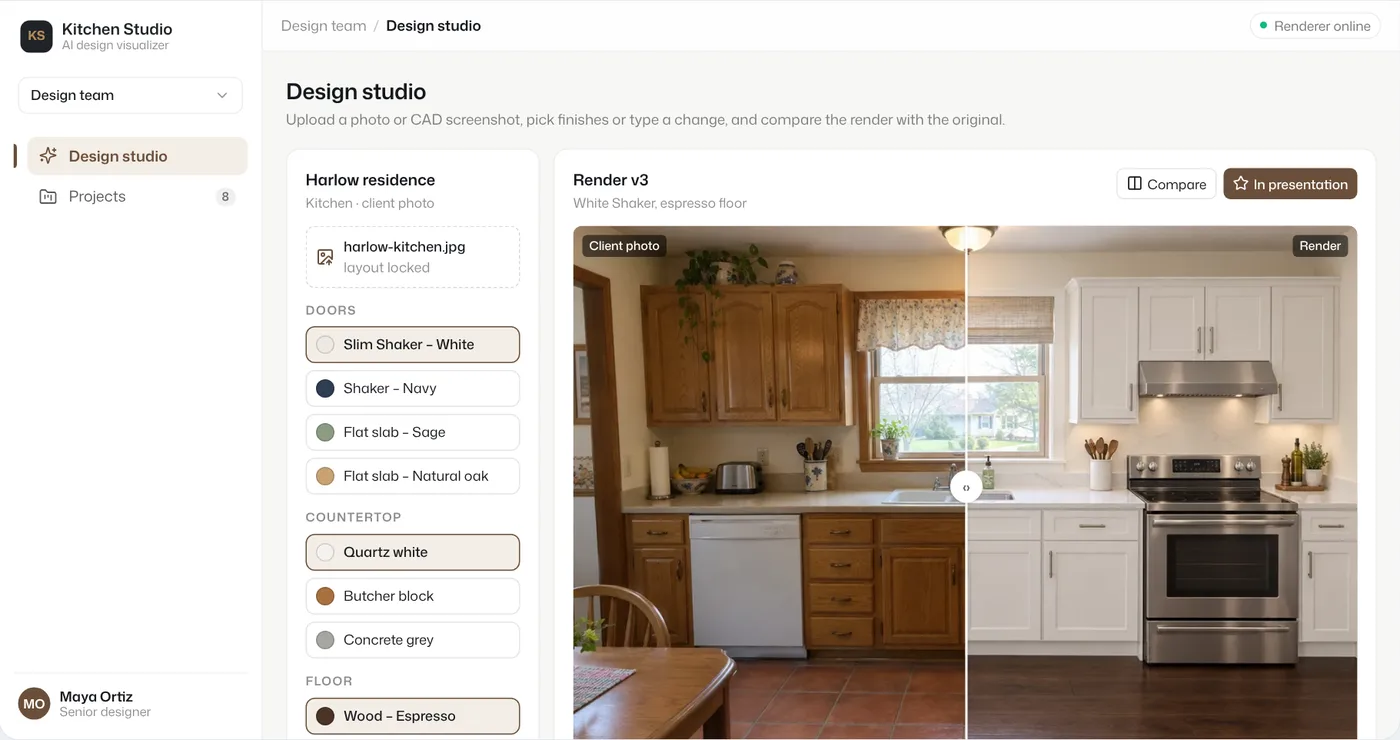
Cost logged on every run: an AI kitchen visualizer
AI runs on · n8n with Gemini 3 Pro Image, Supabase, a React front end
We built a kitchen visualizer for a US kitchen-design firm. A photo or CAD screenshot goes in, and a 2K render with new doors, countertops or floors comes out. The visualizer logs token usage per run, and the token counts of 258 runs gave the cost per render. An image run costs about four times Saltmarsh's agent run. Details on the case page.
The visualizer went on the firm's site for homeowners, and the firm's own design team made 3,962 of about 4,770 renders. A budget planned on homeowner visits would have been wrong; the per-run log showed where the renders came from.
Where a ready-made agent is the better pick
- Support questions answered from your help articles. Intercom Fin charges $0.99 per outcome with a $49 monthly minimum that includes 50 outcomes, and an outcome counts only when the customer confirms the issue is solved, doesn't ask for more help, or Fin completes a procedure. At 100 outcomes a month that is $99, with no build and no upkeep.
- You already run HubSpot Professional or Enterprise. Its customer agent costs $0.50 per resolved conversation, paid in HubSpot credits, and nothing for messages that don't resolve.
- A light job across apps you already connect in Zapier. Zapier Agents include 400 activities a month on Free and 1,500 on Pro, from $33.33 a month billed yearly. An activity is any billable action an agent takes, such as a trigger, a search or an action. If a Saltmarsh quote took an assumed five, 300 requests would use the whole Pro allowance, and the summer peak wouldn't fit.
Saltmarsh keeps its own agent because no ready-made agent knows its rate card or crew sizes, and 300 requests a month already fill the Zapier Agents Pro allowance.
When an agent costs more than it saves
- The volume is small. At 30 requests a month Saltmarsh would save about 5 hours (about $150 at $28 an hour), against about $290 for hosting and two hours a week of upkeep. A Claude Project with the instructions and a person pasting each request in does the same work for the price of a Claude plan.
- Checking takes as long as doing. If a coordinator has to redo the quote to check it, the checking hours stay at 60 and the software bill is pure extra cost.
- The rule is fixed. "If the move is under 10 miles, use the local rate" needs no model. Code or your tool's automation handles it for nothing per run.
- Nobody owns it. When Saltmarsh's rate card changes, someone has to rerun the test set before the agent drafts another quote. Budget those two hours a week before the build starts.
Questions people ask
- How much does an AI agent cost per month?
For your own agent on one job: about $45 of hosting, plus model fees of a few cents a run for most text jobs (Saltmarsh: about 3 cents on Sonnet 5.5). Saltmarsh's 300 quote requests come to about $55 a month in software. Ready-made agents charge per result instead, such as Intercom Fin at $0.99 per outcome. The checking usually costs more than either (Saltmarsh: about $224 a month).
- How much does it cost to build an AI agent?
With Claude Code, a Claude Pro plan while you build plus several weeks of your own evenings for a first agent (our estimate). Hired, it is a quote: the AI Agents Plus guide puts freelance work at $5,000 to $50,000. Most of the time goes into the test set, so ask a hired builder how they test.
- Can I build an AI agent for free?
You can try one for free. Zapier Agents include 400 activities a month on the Free plan, and Anthropic's token counting is free. Running your own agent on every request has a real cost: model fees per run, and hosting that allows commercial use.
- Is AI expensive for a small business to run?
The model is cheap for text jobs: Saltmarsh's quote run costs about three cents on Sonnet 5.5, and hosting is $45 a month. The bigger costs are the build and the 8 hours a month of checking.
- Which costs more, the model or the people?
Usually the people. The OpenClaw cost-per-task page works an example where checking is 98% of the cost of an accepted task. In the Saltmarsh example, checking costs about $224 a month against $55 of software. In Saltmarsh's cost test Haiku cost a twentieth of Sonnet per run but got 6 of 20 crews wrong, and each wrong crew is a coordinator redoing the quote.
- Why do quotes for AI agents vary so much?
Because "agent" covers anything from Saltmarsh's one-call quote draft to a system across many tools with its own logins and dashboard. Send every hired builder the same one-page job description, and the quotes become comparable.