Lovable vs Claude Code: we shipped client apps with both. When to use which

- Published
- 15 November 2026
- Prices checked
- 15 November 2026
Use Lovable when you need working screens on a Supabase database this week and the logic behind them is simple. Use Claude Code when the app must run jobs on its own, talk to several outside systems, or be maintained as normal code. We use both: Lovable for front ends, Claude Code for back ends and whole apps.
Lovable vs Claude Code at a glance
| Question | Lovable | Claude Code |
|---|---|---|
| What it is | A browser app builder. You describe screens in a chat and it writes a React app with a Supabase backend | An AI agent that works inside a code repository: it reads files, runs commands, writes and tests code |
| Where you work | In the browser, with a live preview | In a terminal, the desktop app or the web, next to your Git repo |
| Backend | Lovable Cloud (built on Supabase) by default, or your own Supabase project | Whatever you choose. We use Supabase, Vercel and scheduled jobs |
| Jobs that run with nobody clicking | Possible with backend functions; we keep heavy jobs outside the app | Yes: scheduled jobs, queues and scripts live in the same repo |
| Who owns the code | You. Git sync on every plan, zip download on paid plans | You. It's a normal Git repo from day one |
| Price, checked 15 Nov 2026 | Free tier; Pro $25 a month ($21 billed yearly) for 100 credits; Business $50 | Included in Claude Pro: $20 a month, or $17 billed yearly. Not on the free plan |
| Where we used it | Front ends for Baltoro, NextEnergy, Atlas People, a dental network's Call Hub and a clothing brand's creator CRM | A UK funding broker's two apps, our own Morning Portal and job engine, and this website since October 2026 |
| Where it got stuck for us | Logic that outgrows the screens: batch jobs, big files, many integrations | Needs someone who reads what changed and tests it before it ships |
Swipe the table sideways for all columns. Prices from lovable.dev/pricing, Lovable's plan docs and claude.com/pricing, last checked 15 November 2026. Lovable bills in credits per workspace, not per seat.
The short version: Lovable is the fastest way we know to get a good-looking screen on top of a database. Claude Code is how we build the parts nobody looks at: the pipeline that runs at night, the sync with a CRM, the code a client's developer will maintain.
They overlap more every month. Lovable added a backend, a security scan and two-way GitHub sync. Claude Code can build a front end from a sentence. So ask a different question first: what does this app have to do when nobody is looking at it?
What we shipped with each
Five client front ends of ours started in Lovable. Two client apps, our own internal tools and this website are built in Claude Code. Here are four of them, with the number from each case page and what went wrong.
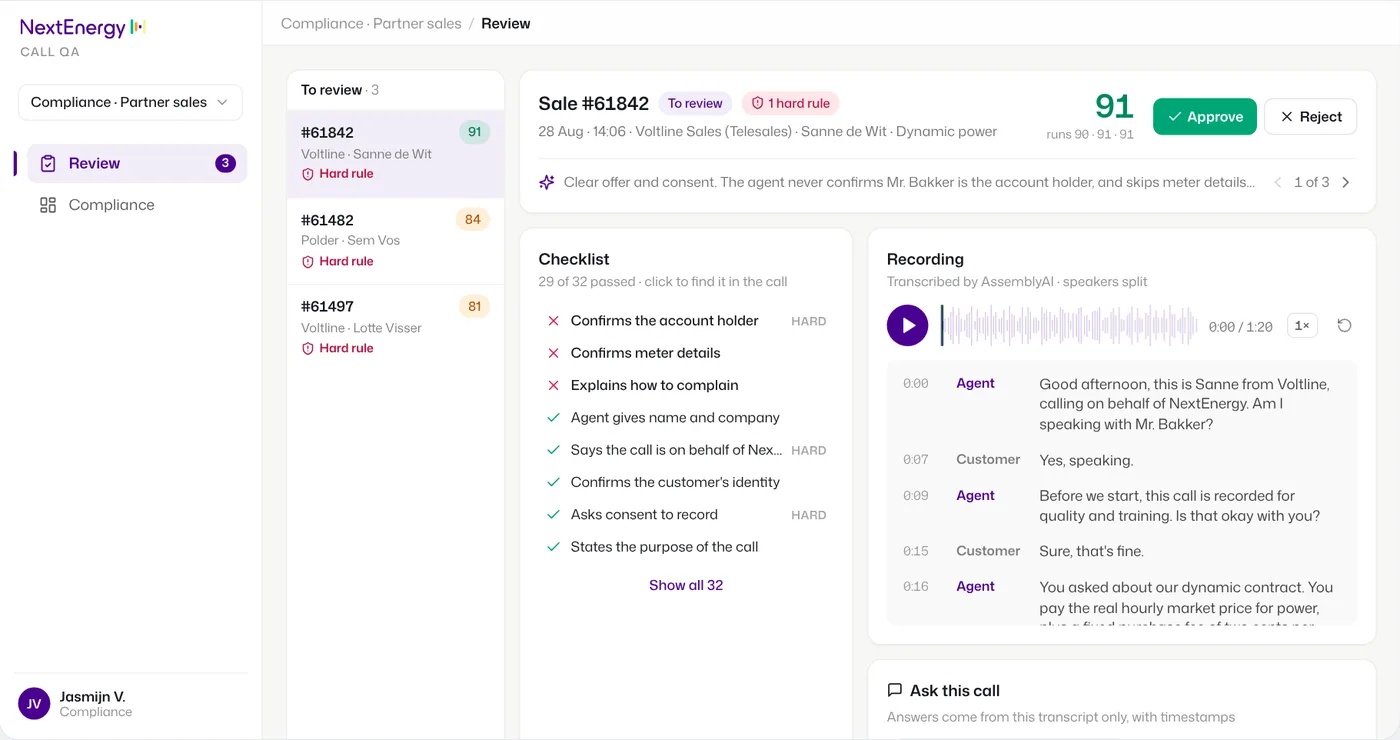
A compliance app for an energy supplier, in Lovable on top of a pipeline
AI runs on · Lovable and Supabase for the app; n8n, AssemblyAI and OpenAI for the pipeline
NextEnergy, a Utrecht energy supplier, checks every partner sales call against Dutch compliance rules. Recordings arrive on FTP. A pipeline transcribes each one, checks it against 30+ yes/no criteria and writes the result to Supabase.
The app staff use every day was built in Lovable: each call with its sale details, the criteria, the transcript and the audio. The first version of the interface took about 10 hours of the 70. A second round added the score-over-time chart, a question bar for asking about one call, the audio and a main-partner column.
The app was never the hard part. The flow it replaced asked a model for one score per call, and scores jumped from 60 to 85 for no clear reason. The fix lived in the pipeline: many narrow yes/no questions, repeated for consistency. Lovable was right for the screens because the logic sat elsewhere.
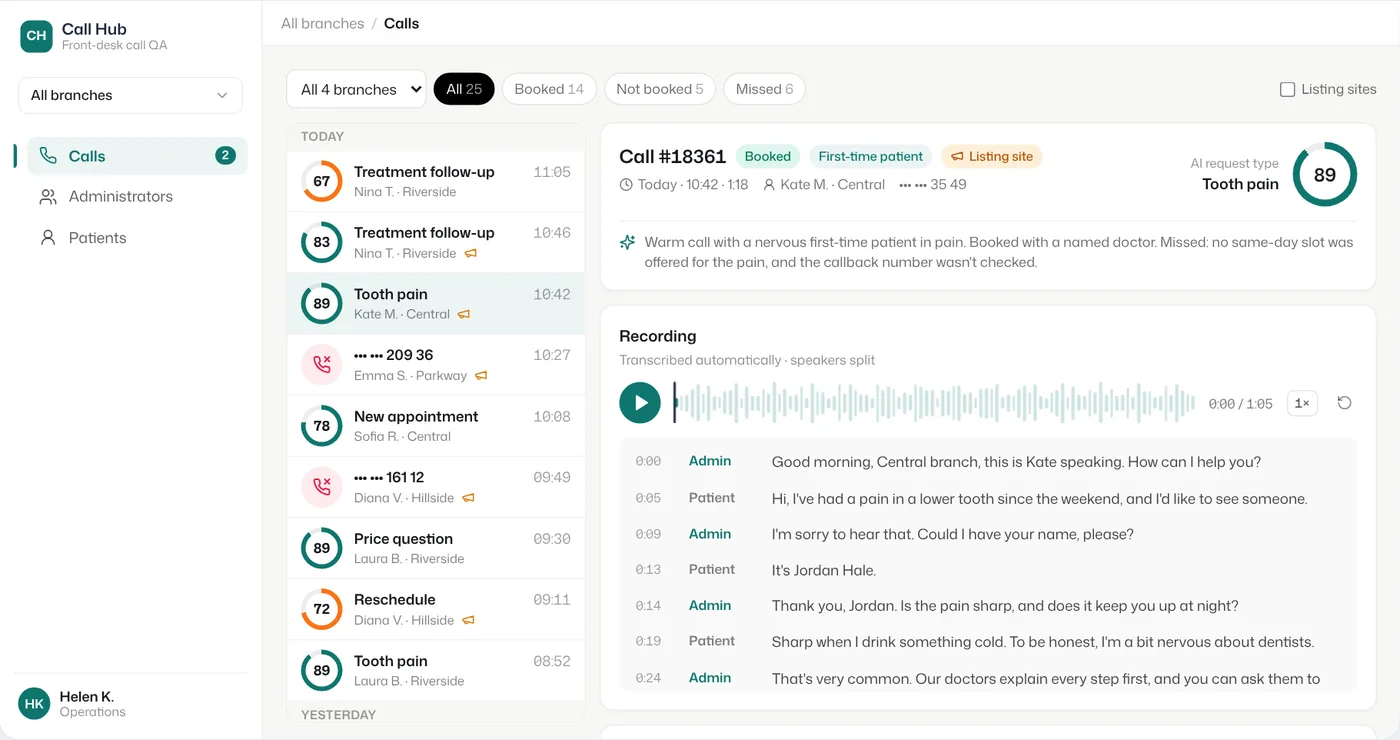
Call Hub for a four-branch dental network
AI runs on · React dashboard started in Lovable; Supabase with Postgres views and SQL functions; n8n and OpenAI GPT
Every front-desk call from four branches is transcribed and scored on 18 criteria, each backed by a verbatim quote. Managers open the Call Hub to see each call, each administrator and each patient's history across branches. It has been in daily use for about two years.
The dashboard began in Lovable. The speed came from the database side: the heavy counting sits in Postgres views and SQL functions, so the screen reads finished numbers. Pages load in 20–40 ms.
The telephony API only answers requests from inside its own region, and the pipeline runs elsewhere. No front-end tool fixes that. A small relay server in the right region did.
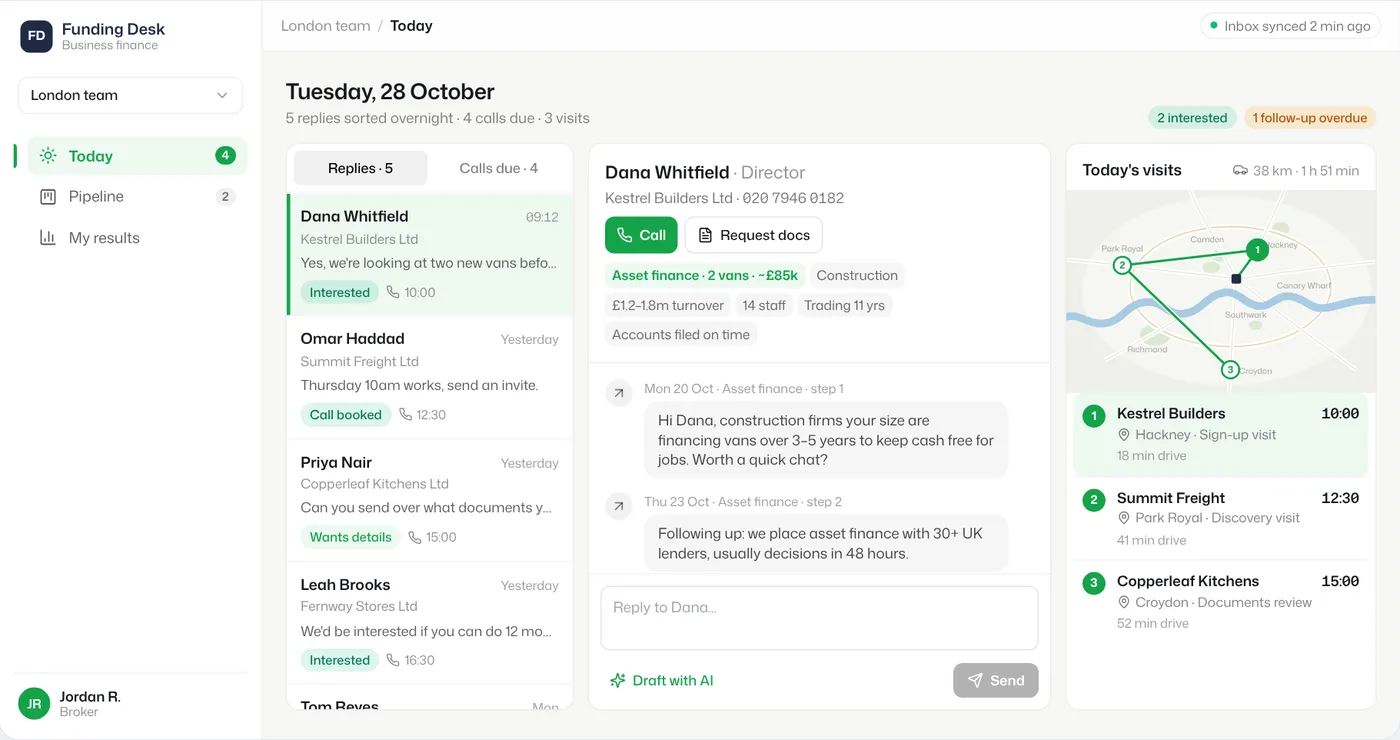
Two apps for a UK funding broker, built in Claude Code
AI runs on · Built with Claude Code. Next.js and Supabase on the client's own Vercel account
This one was Claude Code from the first day, because most of the work happens with nobody clicking. A lead waterfall turns 57,291 companies from UK public registers into 14,620 qualified leads. Outreach replies sync back from Smartlead, an AI step sorts each into one of 8 intents, and 90% are matched to the right contact automatically.
That is a back end with jobs, retries, imports and a CRM sync. In a repo, Claude Code can write it, run it against real data and fix what fails. Both apps were handed over to the client's own Vercel team on 24 October 2026.
The broker's Monday.com board looked automated but wasn't: 32 follow-up rules had stopped firing, and 498 follow-ups were more than 30 days overdue. We audited all 32 and rebuilt the 12 that mattered.
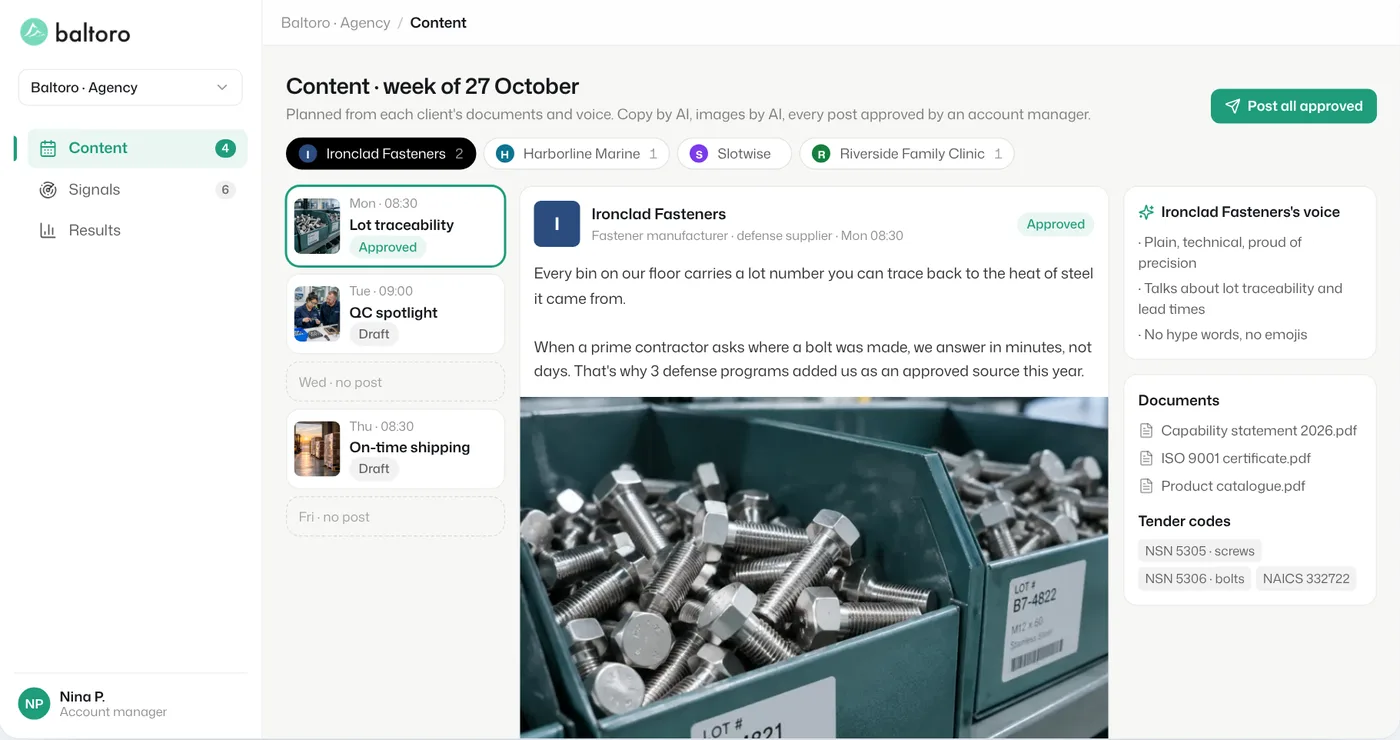
An agency platform that uses both
AI runs on · Lovable, Supabase and n8n, with OpenAI and Gemini; Claude Code for the parts moving into code
Baltoro, a Chicago marketing agency, started with a LinkedIn post generator built in 30 days. It grew into the agency's platform: content in each client's voice, a weekly government-tender hunter for 6 clients, news-trigger leads and a client portal. 22 agency clients use its internal marketing chatbot.
The screens are Lovable on Supabase. As the platform grew, the automations behind it started moving from n8n into code written with Claude Code, starting with the CRM mapping for the client portal.
The tender file was a 70,000-row CSV. n8n crashed on it and Make hung, so someone cleaned it by hand. A separate pre-filter tool now cuts it to about 500 relevant tenders before anything else touches it.
The site you're reading started in Lovable
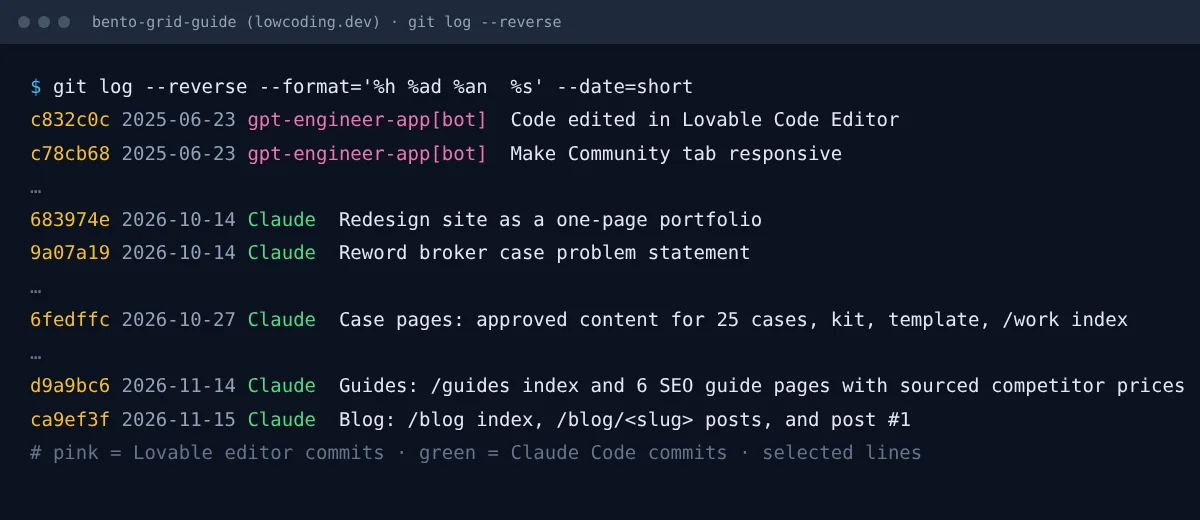
The oldest commits in lowcoding.dev's repository came from Lovable's editor, in June 2025. In October 2026 the work moved to Claude Code in the same repository: the redesign, 25 case pages with their own clickable dashboards, the guides and this blog.
That work is the kind we do in a repo. Each case page has its own small dashboard component. A build script writes plain HTML, the sitemap and structured data for search engines after every build. And the rules for the site (approved claims, which clients can be named) sit in files Claude Code reads at the start of each session.
When Lovable is the right call
- The app is mostly screens over a database. A list, a detail page, a form, a dashboard. Our creator CRM for a clothing brand had a working admin about two weeks after the first spec, built in the client's own Lovable workspace.
- The logic already lives somewhere else. At NextEnergy and the dental network, the pipeline did the hard work. Lovable only had to show the results well.
- The person asking can't read code and wants to change things. Lovable's chat and preview let a founder move a button without a developer.
- You want to test the idea before paying for a build. A clickable version in front of five users tells you more than a spec.
- You're happy on Supabase. Lovable's backend is built on it, and connecting your own Supabase project is supported.
When Claude Code is the right call
- Things must happen with nobody clicking. Our Morning Portal pulls and scores news every night at 01:30 UTC and rolls a Trello board over every Monday. Our job engine runs an AI check on new postings every morning. That's scheduled code, and it sits in the same repo as the screens.
- There are several outside systems. The broker app talks to UK registers, Smartlead, Monday.com and Slack. Each needs retries and logs.
- The data is big. A 70,000-row file doesn't belong in a browser.
- A developer will own it later. A normal repo with tests and migrations is easier to hand over than a chat history.
- You want rules the AI follows every time. Claude Code reads a CLAUDE.md file in the repo at the start of each session. Ours says which claims are approved and which clients stay anonymous.
How to use both on one app
Lovable syncs with GitHub in both directions. Changes made in Lovable go to the repo, and commits pushed to the active branch come back into Lovable (Lovable docs). That's the bridge.
The split we use:
- Screens and layout in Lovable, on one branch it syncs.
- Database changes as SQL migrations in the repo, written and checked in Claude Code.
- Jobs, imports and integrations in Claude Code: scheduled functions, queues or a small server.
- One person decides which tool touches which folder, so the two don't overwrite each other.
Watch three details from Lovable's docs. It edits one branch at a time. If Lovable and GitHub diverge, a push from GitHub replaces Lovable's version (it keeps a backup first). And Lovable can't save files over 10 MB.
Lovable and Claude Code prices, checked 15 November 2026
| Plan | Price | What you get |
|---|---|---|
| Lovable Free | $0 | 5 build credits a day, up to 30 a month; Git sync |
| Lovable Pro | $25 a month, or $250 a year ($21 a month) | 100 credits a month at the base tier, custom domains, no Lovable badge |
| Lovable Business | $50 a month, or $500 a year ($42 a month) | 100 credits at the base tier, SSO, the security center |
| Claude Pro (includes Claude Code) | $20 a month, or $17 a month billed yearly | Claude Code and Cowork, with usage limits |
| Claude Max | $100 a month | 5× Pro usage, for someone in Claude Code all day |
| Claude Team, standard seat | $25 a month, or $20 billed yearly | Claude Code for 2 to 150 people with admin controls |
| Supabase Pro (either tool) | From $25 a month | Daily backups kept 7 days; Free projects pause after a week without activity |
Swipe the table sideways for all columns. Sources: Lovable plans, Claude pricing, Supabase pricing, all read 15 November 2026. Lovable's backend and AI usage is paid from the same credit balance; most small apps stay within the included grant, per Lovable's pricing page.
On paper, both cost about the same for one person: $20–25 a month. In practice the bill depends on how much you change. Lovable charges credits per change. Claude Code on Pro has usage limits; a full day of building can need Max. Neither price includes the database once real users arrive, so budget for Supabase Pro either way.
When not to use either
- The job is a fixed rule in a tool you already pay for. "When the invoice is paid, move the deal" needs your CRM's own automation, not an app.
- Real users and private data, and nobody has checked access. In 2025 a researcher scanned 1,645 apps from Lovable's showcase and found 170 with database tables anyone could read or write (Matt Palmer, CVE-2025-48757). That's a Supabase setup problem, and Claude Code apps can have it too. Our Lovable + Supabase production checklist covers the fixes.
- Nobody will maintain it. An app with no owner breaks the first time an outside API changes. Decide who that person is before you build.
- A spreadsheet still works. If three people use it once a week, keep the sheet.
Moving a Lovable app to Claude Code
Two of our projects went this way: this website, and Tala, an AI ad-creative platform where Mark was co-founder and CPO. Tala's front end started in Lovable; its agents and video pipelines ran on Vercel with Inngest and Claude agents.
The path:
- Connect GitHub in Lovable and let it create the repo.
- Clone it and open Claude Code in the folder. Ask it to read the project and write a CLAUDE.md with the stack, the commands and your rules.
- If the app uses Lovable Cloud, plan the backend move. Lovable doesn't move a project to your own Supabase in one step; you export the database, restore it, then set up storage, logins and secrets again (Lovable docs).
- Deploy to your own Vercel or similar account, with the database in your own Supabase organisation.
- Keep Lovable for screen work if you like, through Git sync, or stop there.
The code is yours either way. Lovable's FAQ says the apps and code you create are yours, with a full download on paid plans.
Questions people ask
- Is Lovable better than Claude Code?
For screens on a database that a non-developer wants to change, yes: it's faster to a working preview. For apps with scheduled jobs, several integrations or code a developer will maintain, Claude Code is better. We use Lovable for front ends and Claude Code for back ends and whole apps.
- Can I use Claude Code on a Lovable project?
Yes. Turn on Lovable's GitHub sync, clone the repo and run Claude Code in it. Commits you push to the branch Lovable syncs come back into Lovable. Agree which tool edits which part, because a push from GitHub replaces Lovable's version of the branch if the two diverge.
- Does Lovable use Claude?
Lovable doesn't say which model it uses. Its FAQ says it uses current leading AI models and picks the model for you, so you can't choose one. Claude Code always runs on Anthropic's Claude models.
- Is Claude Code free?
No. On 15 November 2026 Claude Code came with Claude Pro ($20 a month, or $17 billed yearly), Max ($100 a month), Team and Enterprise. The free Claude plan doesn't include it. Lovable has a free tier of 5 build credits a day, up to 30 a month.
- Can a non-developer use Claude Code?
Yes, for a simple internal tool, especially in the desktop app. The hard part isn't writing code. It's knowing whether the result is safe: who can see which data, what happens when an import fails. If the app holds customer data, get someone who can check that before real users log in.
- Can I move my app off Lovable?
Yes. The code syncs to GitHub on every plan, and paid plans can download the full codebase. If the app runs on Lovable Cloud, moving the backend to your own Supabase project is a manual export and restore, plus setting up storage, logins and secrets again.
SOURCES
- 1.Lovable pricing (lovable.dev) · checked 15 November 2026
- 2.Lovable subscription plans (docs.lovable.dev) · checked 15 November 2026
- 3.Lovable GitHub integration (docs.lovable.dev) · checked 15 November 2026
- 4.Lovable Cloud and moving to your own Supabase (docs.lovable.dev) · checked 15 November 2026
- 5.Lovable FAQ: models and code ownership (docs.lovable.dev) · checked 15 November 2026
- 6.Claude plans and pricing (claude.com) · checked 15 November 2026
- 7.Supabase pricing (supabase.com) · checked 15 November 2026
- 8.Statement on CVE-2025-48757 (Matt Palmer, 29 May 2025) · checked 15 November 2026
- 9.Case: NextEnergy call compliance scoring · checked 15 November 2026
- 10.Case: front-desk call QA for a dental clinic network · checked 15 November 2026
- 11.Case: lead engine and revenue-ops app for a UK funding broker · checked 15 November 2026
- 12.Case: Baltoro, AI platform for a Chicago agency · checked 15 November 2026
Drafted with Claude from our project records; checked and edited by Mark.